
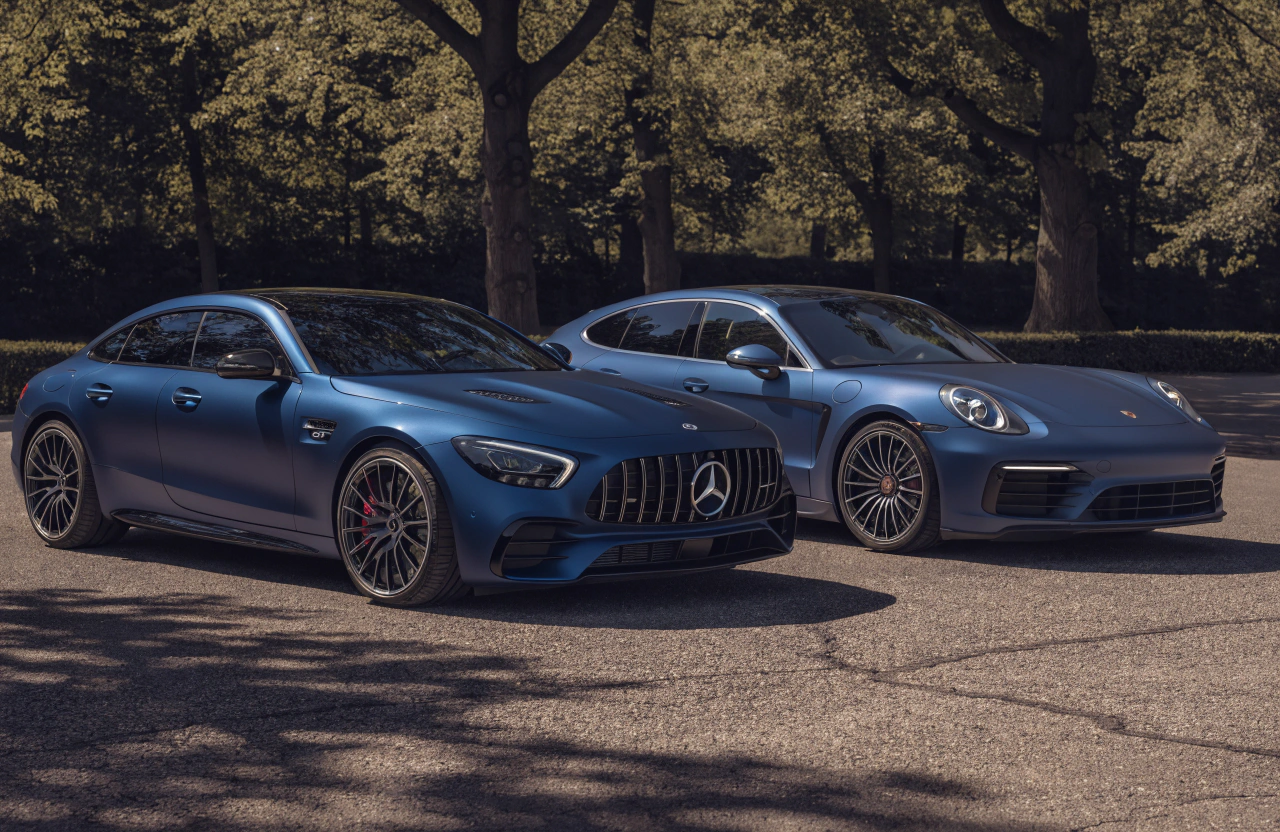
THE GRAND TOURING COUPÉS
Contenders Presented for Judicial Review:
[Car A: 2026 Mercedes-AMG GT 63 S 4MATIC+]
The Doctrine of Theatrical Brutality. A front-engine, hand-built V8 statement that merges grand tourer luxury with track-born aggression. It is emotion weaponized.
[Car B: 2026 Porsche Panamera Turbo S E-Hybrid]
The Doctrine of Computational Perfection. A hybridized, technological tour de force where staggering performance is delivered with clinical precision and layered complexity. It is intellect electrified.
A. INTRODUCTION & THE CONTENDERS: THE DIVERGENT PATH TO ULTIMACY
This is not a mere comparison of specifications. This is a philosophical inquest into the very meaning of performance and luxury at the absolute pinnacle of the four-door coupé segment. It is a clash of ideologies, a debate between the soul-stirring, analog past and the silent, hyper-efficient future, both packaged in breathtakingly fast, lavishly appointed machines.
The 2026 Mercedes-AMG GT 63 S 4MATIC+ exists as a monument to the internal combustion engine’s last stand—a celebration of raw, analog sensation, theatrical acoustics, and a driving experience filtered through mechanical connection rather than digital interpretation. It is an athlete that sweats.
The 2026 Porsche Panamera Turbo S E-Hybrid embodies the inevitable, hyper-efficient future—a symphony of electrified torque, adaptive systems, and a chassis so intelligent it anticipates the road. It is an athlete that calculates.
This investigation answers a singular, critical question: In the pursuit of ultimate performance, luxury, and ownership, does soulful brutality or omniscient perfection reign supreme?
B. THE SPECIFICATION INQUISITION: THE CANONICAL DATA FIELD
THE AUTORANK’S SPEC BOX: THE CANONICAL DATA
2026 Mercedes-AMG GT 63 S 4MATIC+
- Powertrain: 4.0L Hand-built “M178” Twin-Turbo V8
- Total Output: 630 hp / 664 lb-ft
- Transmission: AMG SPEEDSHIFT MCT 9-Speed Automatic
- Drivetrain: AMG Performance 4MATIC+ (Fully Variable AWD)
- Curb Weight: 4,650 lbs (est.)
- 0-60 mph (Manufacturer Claim): 3.1 sec
- Top Speed: 195 mph (Governed)
- EPA Fuel Economy (Combined): 17 mpg (est.)
- Real-World Observed Fuel Economy: 14-15 mpg
- Starting MSRP (USA): $182,000 (est.)
2026 Porsche Panamera Turbo S E-Hybrid
- Powertrain: 4.0L Twin-Turbo V8 + High-Performance Electric Motor
- Total Output: 690 hp / 642 lb-ft (Combined)
- Transmission: PDK 8-Speed Dual-Clutch Automatic
- Drivetrain: Porsche Traction Management (PTM) AWD
- Curb Weight: 5,290 lbs (est.)
- 0-60 mph (Manufacturer Claim): 3.0 sec
- Top Speed: 196 mph (Governed)
- EPA Fuel Economy (Combined): 46 MPGe / 21 mpg (est.)
- Real-World Observed Fuel Economy: 20-22 mpg (Hybrid), ~20 mi EV-only range
- Starting MSRP (USA): $207,000 (est.)
C. CATEGORICAL DISSECTION: THE FIVE PILLARS OF JUDGMENT
1. PERFORMANCE: THE PHYSIOLOGY OF SPEED
Acceleration & Powertrain Character:
- Mercedes-AMG GT 63 S: The experience is orchestral and linear. The hand-built M178 V8 delivers torque with a deep-chested, relentless swell. The 9-speed MCT transmission executes upshifts with a violent, percussive thump that shakes the chassis. There is a tangible, mechanical drama to building speed—it is earned, and felt through the seat and spine. Launch control is an event, accompanied by tire smoke and a ferocious bark. This is a powertrain with a story to tell, and it narrates it at 130 decibels.
- Porsche Panamera Turbo S E-Hybrid: The experience is instantaneous and silent, then explosive. From a standstill, the e-motor’s immense torque is available at 0 RPM, resulting in a surreal, silent, neck-snapping shove before the V8 awakens with a metallic roar. The PDK’s shifts are clinically fast and seamless. Speed is deployed, not built. It feels like a technocratic magic trick—devastatingly effective but slightly detached, as if the true work is being done in a hidden server room behind the firewall.
Handling, Grip, & Chassis Dynamics:
- Mercedes-AMG GT 63 S: It disguises its weight with heroic, muscle-bound tenacity. The steering is heavy, direct, and communicates through a layer of artificial heft rather than pure feedback. It changes direction with deliberate, stable aggression. The rear-biased AWD can be provoked into playful slides, and Drift Mode unlocks a raw, tail-happy persona. It feels like a heavyweight boxer—powerful, balanced, and capable of shocking agility. You feel its mass, but you also feel its strength overcoming it.
- Porsche Panamera Turbo S E-Hybrid: This is a masterclass in computational chassis management. The standard rear-axle steering, active anti-roll bars (PDCC), and torque-vectoring make its staggering 5,290 lbs feel like a mirage. It rotates with supernatural neutrality and mid-corner stability. The steering is hyper-precise, lightning-quick, and utterly numb. The limit is so high and so sanitized that it can feel like you are operating a simulator with perfect physics. It is the more capable machine on a circuit, but the less engaging one on a visceral level.
Braking & Track Endurance:
- Mercedes-AMG GT 63 S: The standard carbon-ceramic brakes offer immense, fade-resistant stopping power with a firm, progressive pedal. On track, the V8’s heat and the sheer mass lead to earlier thermal limitations compared to the Porsche. It is a sprinter, not a marathon runner.
- Porsche Panamera Turbo S E-Hybrid: The hybrid system’s regenerative braking complicates initial pedal feel, blending friction and regeneration in a way that takes acclimation. The combination of massive carbon ceramics and the battery’s mass low in the chassis gives it astonishing, repeatable braking performance. Its ability to manage heat and hybrid system energy on a sustained lap is a technological marvel, defying its portly curb weight.
2. LUXURY & INTERIOR: THE MATERIAL SANCTUM
Material Hierarchy & Craftsmanship:
- Mercedes-AMG GT 63 S: The cabin is a nightclub merged with a machine shop. It is dominated by Nappa leather, Dinamica microsuede, and real metal. The design is dramatic, driver-focused, and intentionally flamboyant, with twin-spoke steering wheels and turbine-style vents. The build quality is solid, though some secondary switchgear can feel less than bespoke. It appeals to the id—it is a place of passion and performance.
- Porsche Panamera Turbo S E-Hybrid: The cabin is a silicon valley boardroom. Materials are cool to the touch: anodized aluminum, glass-look surfaces, and exquisite, flawless leather. The build quality is faultless, with tolerances measured in microns. The design is minimalist, horizontal, and focused on clean lines. It is serene, spacious, and intellectually satisfying. It appeals to the super-ego—a place of control and curated calm.
Seating, Ergonomics, & Ambiance:
- Mercedes-AMG GT 63 S: The AMG Performance seats are sculptural, aggressively bolstered thrones. The driving position is perfect, low, and encasing, reinforcing the cockpit feel. The ambient lighting is theatrical, with 64 colors. It is an immersive, exciting environment that can feel overwhelming on a long, quiet drive. It is a stage, and you are the lead performer.
- Porsche Panamera Turbo S E-Hybrid: The 18-way adaptive sport seats offer peerless support with less aggressive bolstering. The driving position is similarly perfect, with exceptional visibility outward. The ambiance is one of calm, digitally-controllable serenity. It is the more restful, less fatiguing place to spend extended time. It is a sanctuary that happens to be capable of warp speed.
3. TECHNOLOGY & FEATURES: THE DIGITAL CORTEX
Infotainment & User Interface:
- Mercedes-AMG GT 63 S (MBUX Hyperscreen): The hyperscreen is a staggering, wall-to-wall visual spectacle. Three separate screens flow under a single curved glass panel. It is powerful, customizable, and deeply impressive. The learning curve is steep, and the reliance on touch-sensitive controls and “Hey Mercedes” voice commands can be distracting while driving. It is technology as theater, sometimes at the expense of pure usability.
- Porsche Panamera Turbo S E-Hybrid (Porsche Communication Management): The central 12.3” touchscreen is flanked by physical, haptic-feedback buttons for climate control—a critical ergonomic advantage that Porsche refuses to abandon. The interface is faster, more logical, and less prone to fingerprint smudges. The optional passenger display is a thoughtful, non-distracting addition. It is technology as a precise tool, not the main attraction.
Driver Assistance & Advanced Systems:
- Both offer sophisticated Level 2 highway assist systems (Adaptive Cruise + Active Lane Centering). The Porsche’s system is marginally smoother and more confidence-inspiring in its lane-keeping. However, the Panamera’s true technological ace is its extensive, optional suite of active chassis systems (PDCC Sport, Rear-Axle Steering, 3-Chamber Air Suspension), which represents a significant, tangible advantage in dynamic capability, albeit at great financial cost.
Signature Audio Systems:
- Mercedes-AMG GT 63 S (Burmester 3D High-End): 1,450 watts, 25 speakers. Sound signature is warm, rich, and concert-hall dramatic. Perfect for classical or the deep bass of the V8’s own soundtrack. It complements the car’s theatrical nature.
- Porsche Panamera Turbo S E-Hybrid (Burmester 3D High-End Surround): 1,455 watts, 21 speakers. Sound signature is crisper, more analytical, with breathtaking clarity and soundstage precision. The reference choice for critical listening. It matches the car’s ethos of flawless reproduction.
4. PRACTICALITY & DAILY USE: THE LIVING MACHINE
Ride Comfort & Noise Isolation:
- Mercedes-AMG GT 63 S: In Comfort mode, the ride is firm but compliant, absorbing sharp impacts well. The dominant characteristic is the ever-present V8 rumble—a feature, not a bug. Highway cruising is stable but never silent; the soundtrack is your constant companion. It is a grand tourer for those who find silence overrated.
- Porsche Panamera Turbo S E-Hybrid: With its standard 3-chamber air suspension, the ride is nothing short of miraculous. It glides over imperfections in a way that defies its performance capability. In EV mode, it is library-quiet. On the highway, it is a vault of serenity, effortlessly covering vast distances. It is the vastly superior daily driver and long-distance grand tourer when measured by comfort and isolation.
Real-World Usability & Running Costs:
- Mercedes-AMG GT 63 S: Fuel stops will be frequent and expensive. Tire replacement (especially the massive rears) will be a predictable, costly expense. Its lower overall system complexity (despite the sophisticated engine) may lead to lower long-term repair costs outside warranty, but consumables are brutally expensive.
- Porsche Panamera Turbo S E-Hybrid: The ability to complete daily commutes (~20 miles) on electric power alone can drastically reduce fuel costs for urban owners. However, the staggering complexity of the hybrid powertrain, high-voltage battery, and active chassis systems suggests exponentially higher potential repair costs after the warranty expires. It is a technologically breathtaking, but financially perilous, long-term proposition.
5. VALUE & OWNERSHIP: THE COST OF SOVEREIGNTY
Depreciation & Cost-to-Own Projections:
- Mercedes-AMG GT 63 S: Historically, AMG GT 4-doors have experienced steep initial depreciation, stabilizing thereafter. The hand-built engine, limited production, and iconic AMG status may bolster long-term collectibility among enthusiasts who revere the V8 era.
- Porsche Panamera Turbo S E-Hybrid: Porsche models, particularly hybrid flagships, traditionally exhibit the strongest residual values in the sector. The Panamera Turbo S E-Hybrid’s technological significance may make it a future classic, though reliance on a complex, aging high-voltage battery pack is a significant wildcard for decade-long ownership.
Warranty & Maintenance Philosophy:
- Both offer a standard 4-year/50,000-mile bumper-to-bumper warranty. The Porsche’s hybrid components carry an 8-year/100,000-mile federal emissions warranty (specifically covering the battery). Porsche’s prepaid maintenance plans are more comprehensive but come at a significant premium. Mercedes-AMG’s first-service inclusive program is less extensive but standard.
D. THE DRIVING VERDICT: A SYMPHONY VS. AN ALGORITHM
On the Same Winding Road:
You enter Corner One in the Mercedes-AMG GT 63 S. You feel the weight transfer through your thighs, hear the exhaust bark on the aggressive downshift, wrestle with the heavy steering, and apply the power early, feeling the rear axle subtly push you out. The experience is physical, aural, and deeply satisfying. You are managing a force of nature.
You enter Corner One in the Porsche Panamera Turbo S E-Hybrid. The car remains perfectly flat. The steering wheel requires a flick of the wrist. The powertrain responds instantly and silently to your throttle input. You carry more speed, with less effort, and exit with robotic precision. The experience is cognitive, visual, and awe-inspiring. You are directing an intelligence.
E. THE FINAL DECLARATION: THE DOCTRINE OF DIVERGENT PERFECTION
THE PROFILE VERDICTS: THE ARCHETYPES OF EXCELLENCE
The ultimate failure of analysis is to force a singular champion where none exists. True excellence diverges. The final reckoning reveals not a winner, but a sovereign for each kingdom.
- FOR THE SEEKER OF VISCERAL TRUTH: For the driver who believes performance is a symphony of sensation—a dialogue conducted through steering weight, an orchestra of unadulterated mechanical combustion, and the palpable transfer of mass you must master with your own hands—the domain is ruled by the 2026 Mercedes-AMG GT 63 S 4MATIC+. It is the final, magnificent edifice of the analog age. Its victory is not in laptimes, but in the permanence of the memory it etches upon your nervous system. You do not drive it; you conduct it, and it roars back in approval.
- FOR THE DEMANDER OF OMNISCIENT MASTERY: For the individual who defines the apex as the total dissolution of compromise—where silent, electric serenity and explosive, hybridized force coexist, where the chassis itself thinks in microseconds to grant you preternatural calm or limitless grip—the throne belongs to the 2026 Porsche Panamera Turbo S E-Hybrid. It is not a car; it is a technological covenant. Its victory is in its absolute authority across every conceivable parameter of the modern driving condition. You do not drive it; you delegate to its genius, and it executes with flawless precision.
- FOR THE CURATOR OF LEGACY & VALUE: For the patron who views an automobile as both an emotional asset and a financial instrument, where peerless build integrity, enduring brand sovereignty, and the foresight of technological relevance safeguard one’s investment—the crown passes to the Porsche. It represents the rational apex of the ownership calculus, with stronger projected residuals and a warranty structure that acknowledges its hybrid core.
- FOR THE PURIST OF PLAY & ENGAGEMENT: For the enthusiast who finds nirvana not in the perfect lap, but in the perfect slide—who seeks a machine that invites provocation, rewards skill with adjustability, and communicates its limits with honesty rather than electronic intervention—the scepter is held by the Mercedes-AMG. Its victory is in the grin it imprints on your face when the electronics are set to “Basic” and the road is yours.
THE FINAL, UNIFYING PRINCIPLE: THE END OF THE BINARY
To declare a singular “overall” victor between these machines is to misunderstand their fundamental natures. It is to ask whether a masterfully hand-forged katana is “better” than a particle-beam weapon. The question is a category error.
This is not a tie. It is a schism of purpose.
The 2026 Mercedes-AMG GT 63 S 4MATIC+ is the definitive conclusion of a centuries-old philosophy: Man as the master of Machine. It is a testament to sensory connection, theatrical emotion, and the raw, unadulterated joy of combustion. It is for the driver who measures satisfaction in decibels, in steering wheel fight, and in the sweet ache of a journey physically earned.
The 2026 Porsche Panamera Turbo S E-Hybrid is the pioneering manifesto of the new paradigm: Machine as the extension of Human Will. It is a testament to computational brilliance, serene capability, and the awe of a system whose limits surpass your own. It is for the driver who measures satisfaction in effortless velocity, in silent, city-spanning electric range, and in the flawless execution of intent.
Therefore, the ultimate decision is not which car is better.
It is a question of which doctrine you swear allegiance to.
Choose the AMG if you believe the soul of driving is felt in the struggle, the sound, and the raw, mechanical conversation.
Choose the Porsche if you believe the pinnacle of driving is achieved in the transcendence of limitation, the peace of perfection, and the quiet confidence of absolute capability.
One is the greatest, most visceral expression of the automotive past and present.
The other is the undeniable, uncompromising blueprint for the future.
You do not choose between a better and a worse car. You choose between two different, and equally profound, definitions of what it means to own the ultimate.