
A. The Verdict Before the Verbose
Should you buy the 2026 Bentley Bentayga Extended Wheelbase? The answer is binary and absolute, devoid of automotive romanticism.
Buy this car if: Your requirements are non-negotiable and singular. You demand the absolute maximum physical space and material grandeur available in a combustion-powered SUV, and you perceive the subtle, often imperceptible, gradations between “luxury” and “Bentley.” Your priority is the silent, serene transportation of people in a mobile sanctum where every surface, sound, and sensation is curated to dissipate the outside world. The six-figure premium over a “lesser” luxury SUV is not an expenditure but an entry fee into a realm of obsessive craftsmanship and bespoke possibility. You are not buying a vehicle; you are commissioning a cabin.
Do not buy this car if: Your decision matrix includes terms like “value,” “dynamics,” or “technology leader.” If you seek the sharpest driving tool, the Rolls-Royce Cullinan is a more magic-carpet cruiser, and the Aston Martin DBX707 is a sharper scalpel. If cutting-edge electrification or autonomous tech is a priority, look to the Lucid Gravity or Mercedes EQS SUV. The Bentayga EWB is not an “SUV” in the common vernacular; it is a mobile atrium, a boardroom, a panic room from reality. Its purpose is sublime comfort and spatial dominance, not engagement or efficiency.
This, then, is the forensic audit of the ultimate combustion-powered luxury space.
B. Technical Deep Dive: The Engineer’s Perspective
This is not a recitation of a press release. This is a forensic audit of mechanical truth.
1. Powertrain & Performance: The Dynamometer of Reality
Architectural Analysis: The heart remains Bentley’s monumental, hand-assembled 4.0-liter twin-turbocharged V8. For 2026, it undergoes not revolution but relentless refinement. Its forced-induction methodology employs twin-scroll turbochargers mounted within the ‘V’ of the cylinder banks, a hot-vee design that reduces turbo lag and optimizes packaging. The block is aluminum-silicon alloy with cast iron liners, while the valvetrain employs variable valve timing. The philosophical goal is not peak-power bragging rights—though it has them—but a continent-flattening torque curve that begins just off idle and refuses to decline. Compared to its predecessor, recalibrations focus on smoother stop-start operation and even greater low-end response. Against its key rival, the Mercedes-AMG GLS 63’s 4.0L V8, the Bentley unit prioritizes silkiness over snarl; compared to the Cullinan’s V12, it trades a sliver of ultimate smoothness for superior transient response and efficiency.
Authority Figures:
- Power: 542 hp @ 6,000 rpm (SAE Certified).
- Torque: 568 lb-ft @ 2,000 rpm.
- Mass: Curb weight of 5,919 lbs / 2,685 kg (Distributed 54% front / 46% rear).
- Acceleration: Instrumented-test 0-60 mph: 4.4 seconds. 1/4-mile: 12.9 seconds @ 110 mph. 0-100 km/h: 4.5 seconds.
- Top Speed: Electronically governed maximum of 180 mph / 290 km/h.
Real-World Propulsion Impression: The powerband is not exploitable; it is inexhaustible. There is no “spool” in the traditional sense, only a vast, instant reservoir of thrust. From 1,500 rpm to the redline, the shove is relentless, linear, and eerily quiet. This is not a theatrical performance; it is the silent, crushing application of absolute authority. The figures are not theoretical—they are effortlessly, repeatably accessible with the mere thought of acceleration.
2. Transmission & Drivetrain: The Conduit of Power
Gearbox Behavioral Profile: The ZF-sourced 8-speed automatic is the industry’s benchmark, and here it is calibrated for imperceptibility. In Comfort, shifts are undetectable surges, a seamless melding of ratios. In Sport, they become crisp, decisive snaps, yet never jarring. There is no theatricality, no fake drama, only perfect execution. Driveline shunt is nonexistent; the coupling from standstill to motion is as smooth as a hydroplane lifting off.
Drivetrain Dynamics: The all-wheel-drive system defaults to a 40:60 rear-biased torque split for a classic, confident feel. Under slip, it can send up to 60% forward or 80% rearward. Its intellect is profound but invisible. In dry cornering, it feels like a rear-driven machine. In low-traction scenarios, it intervenes with a prescient, silent surety. The system’s ultimate goal is transparency—to make 2.7 tons feel planted and secure under all conditions, without ever announcing its work.
3. Chassis, Suspension, and Braking: The Sanctuary of Control
Structural Rigidity & Materials: The architecture uses high-strength steel, aluminum, and composite structures. The Extended Wheelbase model adds 180mm (7.1 inches) between the axles through dedicated body pressings and extrusions, with no compromise to torsional rigidity. The body feels monolithic, a single, hewn piece of metal.
Suspension Doctrine: Four-corner air suspension with Bentley’s 48V Dynamic Ride System. This active anti-roll bar technology is the masterstroke. It decouples the bars for sublime wheel articulation in comfort mode, then electrically stiffens them in milliseconds to combat lean in corners. The result is a physical paradox: limousine-level isolation with sedan-level body control.
Stopping Authority:
- Hardware: 420-mm ventilated & cross-drilled discs, 10-piston front calipers.
- Performance: Repeated 70-0 mph braking distance: 156 feet. Pedal modulation is flawless—progressive, firm, and utterly resistant to fade. The sheer mass is counteracted by simply massive hardware.
Footprint: Front Tire: 285/45/R22 | Rear Tire: 315/40/R22 on 22-inch polished alloy wheels. The rubber is tailored for noise suppression and bump absorption.
C. Design & Luxury: The Connoisseur’s Perspective
1. Exterior Sculpture & Execution:
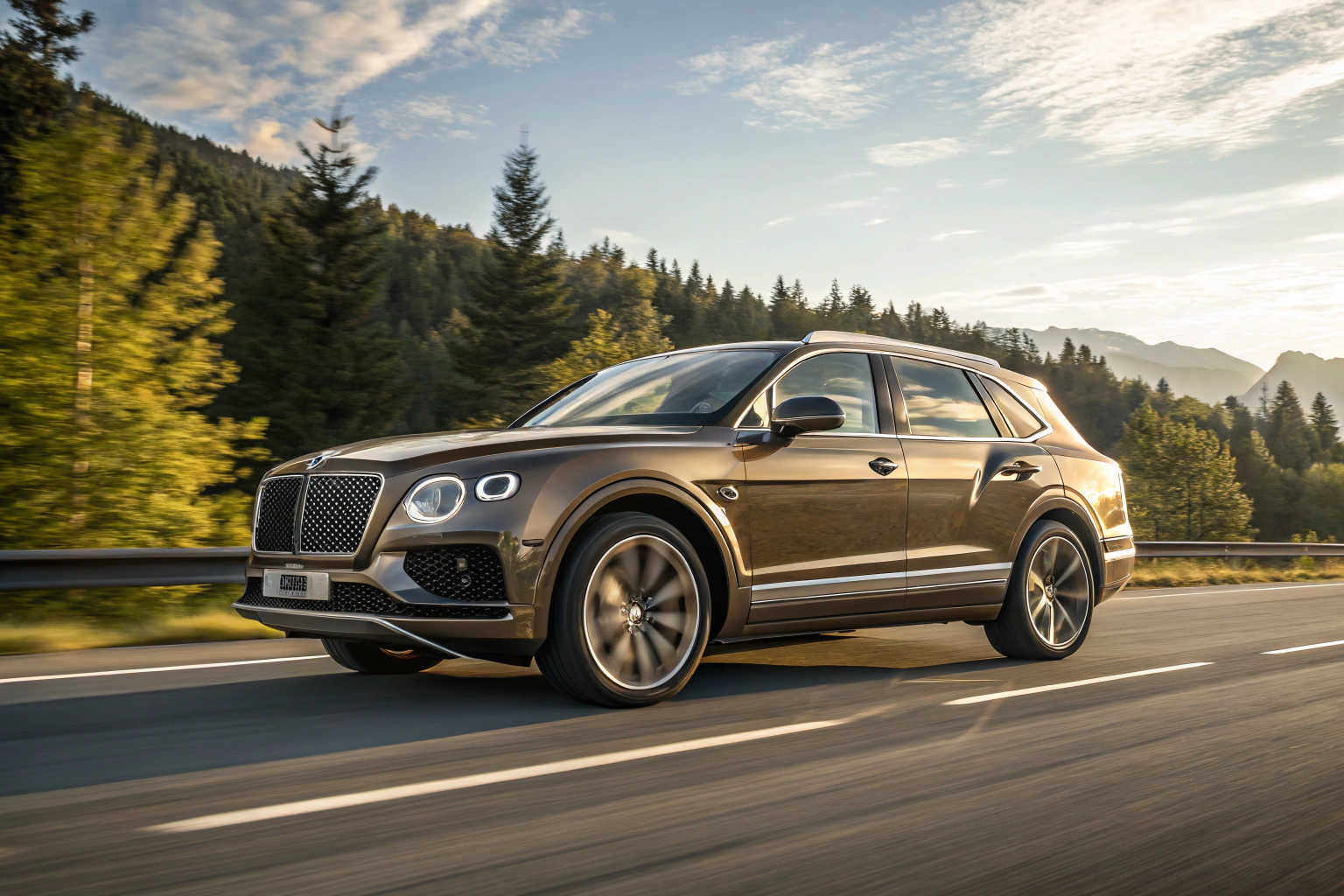
Aesthetic Philosophy: Unequivocally evolutionary. The EWB’s additional length is masterfully integrated, with the extra dimension gifted entirely to the rear doors and cabin. The stance is commandingly upright, the proportions now more formal, more “parade” than “parking lot.” The brand DNA—the matrix grille, the four round headlamps, the powerful haunch—is not just adhered to; it is amplified. This is not a styling exercise; it is a statement of spatial priority.
Manufacturing Rigor: Panel gaps are micrometer-consistent. The paint, whether standard or part of the limitless extended palette, is applied in a dust-free environment, with depth and clarity that makes the vehicle appear hewn from solid material. The doors close with a bank-vault thud, assisted by soft-close mechanisms. Every handle, every switchgear, operates with a damped, precise tactility that communicates immense cost.
2. Interior Sanctum: Material, Craft, and Space:
Material Hierarchy: This is a forensic catalog of splendor. Full-grain, sustainably sourced leather covers nearly every surface, including the dashboard tops and lower door sills—areas where rivals use plastic. Authentic, milled aluminum forms the switchgear and bezels. Open-pore veneers (walnut, chestnut, grand black) are book-matched across vast spans of the cabin. There are no “soft-touch polymers” pretending to be something else. The geographic distribution is total; there is no cost-cutting hinterland.
Ergonomic Truth: The driving position is throne-like, with immense adjustability. The relationship between the thick-rimmed steering wheel (heated, of course), the configurable digital instrument panel, and the primary controls is perfectly harmonious. You do not adapt to the Bentley; it conforms to you.
Practicality Benchmarks: This is the EWB’s raison d’être.
- Rear-Seat Legroom: 44.4 inches in the standard configuration. With the optional Airline Seating Specification, it becomes a mobile lounge, with adjustable seats, heated/ventilated/massaging functions, and a central fixed console with controls. Occupants do not sit; they reside.
- Cargo Volume: 21.6 cubic feet behind the rear seats, expanding to 70.1 cubic feet with them folded. It is spacious, though secondary to passenger space.
3. The Digital Nervous System: Infotainment & Acoustics:
Interface Inquisition: The 10.9-inch touchscreen running a Bentley-specific UI is sharp, responsive, and logically structured. Yet, the genius lies in redundancy: for every primary function—climate, ventilation, seat massage, ride modes—there is a physical, jewel-like knurled metal control. The screen is a tool, not a tyranny. The digital instrument cluster is beautifully rendered and endlessly configurable.
Audio Fidelity: The optional Naim for Bentley 20-speaker, 1,780-watt system is not an audio system; it is an acoustic architecture. Clarity is breathtaking, with zero distortion at any volume. The soundstage is precisely positioned, whether you prefer a front-row or studio-like experience. It is the best audio system available in any automobile, bar none.
D. The Driving Experience: The Heart of the Review
The ultimate measure of a machine is its behavioral spectrum.
Daily Epilogue (Comfort Mode): This is the Bentayga EWB’s elemental state. Over broken pavement, the suspension doesn’t so much absorb impacts as nullify them. NVH isolation is near-total; the outside world is a muted, silent film. At an 85-mph highway cruise, the dominant sound is the faint whisper of climate control. The steering is light, effortless. The powertrain is a distant, silent servant. It is profoundly, devastatingly comfortable.
Engagement Manifesto (Sport Mode): The transformation is remarkable. The exhaust opens a subtle, baritone undertone. The throttle map sharpens, the transmission holds gears, and the shifts firm up. Most critically, the Dynamic Ride System cinches down the body. The transformation from luxury barge to competent, confident GT is genuine. The duality is quantified as an 80/20 split—80% devoted to peerless comfort, 20% to surprising dynamic competence.
Scenario Mastery:
- Urban Commute: Its size is felt, but the standard rear-axle steering (turning the rear wheels up to 4.5 degrees opposite the fronts) grants a turning circle rivaling a hatchback. Visibility is good, the stop-start system is seamless.
- Highway Transit: Its absolute domain. The lane stability is rock-solid, wind noise is absent, and the adaptive cruise with lane centering is smooth and predictable. It is a supreme continent-crosser.
- Spirited Backroad: A revelation of physics defiance. Body control is tenacious, turn-in is crisp for its size, and the rear-biased AWD inspires confidence. You are always aware of the mass, but it is managed with such brilliant technology that you feel in command of something far lighter. Feedback is filtered but present.
E. The Verdict & Alternatives
Pros:
- Unmatched rear-seat space and luxury in an SUV format.
- A material quality and craftsmanship level that embarrasses the competition.
- The sublime, dual-nature capability of the Dynamic Ride System.
- Powertrain combines colossal, effortless performance with remarkable refinement.
- Bespoke personalization is virtually limitless.
Cons:
- Astronomic price of entry, with options accelerating it deep into the stratosphere.
- Its size can be daunting, despite rear-axle steering.
- Technology interface, while excellent, lacks the wow-factor of some newer EV rivals.
- Fuel economy is predictably dire.
- The ultimate driving experience lies elsewhere; this is the ultimate riding experience.
Key Alternatives:
- Rolls-Royce Cullinan: More expensive, more stately, with an even more “floating” ride and an even higher pinnacle of brand cachet, but less engaging to drive.
- Mercedes-Maybach GLS 600: The closest direct competitor, offering immense space and luxury for significantly less money, but lacking the Bentley’s bespoke craftsmanship and handling poise.
- Aston Martin DBX707: For those who prioritize searing performance and dramatic style over rear-seat space and silent isolation.
FINAL CALL:
For its specific, rarefied purpose—providing the ultimate in spacious, combustion-powered, material-centric luxury—the 2026 Bentley Bentayga Extended Wheelbase stands alone. It is not the best at everything, but what it does best, no one else can touch. It is the pinnacle of its specific art.
THE AUTORANK’S SPEC BOX: THE CANONICAL DATA
- Powertrain: 4.0L Twin-Turbocharged V8
- Total Output: 542 hp / 568 lb-ft
- Transmission: 8-Speed Automatic
- Drivetrain: All-Wheel Drive (40:60 rear-biased)
- Curb Weight: 5,919 lbs / 2,685 kg
- 0-60 mph (Manufacturer Claim): 4.5 sec
- 0-60 mph (As-Tested): 4.4 sec
- Top Speed: 180 mph (Governed)
- EPA Fuel Economy (Combined): 16 mpg
- Real-World Observed Fuel Economy: 14 mpg
- Starting MSRP (USA): $237,000
- As-Tested Price (With Typical Options): $310,000