
A. Introduction & User Intent: The Decisive Verdict
Should you buy this car? The answer is a definitive Yes, but with a critical, two-part caveat.
Buy the 2026 Cadillac Lyriq AWD if: You seek a preeminent, long-range electric luxury SUV whose primary mission is serene, continent-swallowing travel, enabled by the industry’s most competent hands-free driving system. Your priorities are a sanctuary-like cabin, exemplary build quality that finally challenges the German establishment, and a driving character tuned for effortless, isolating comfort. You are an early-adopting traditional luxury buyer, ready for an EV but unwilling to compromise on material tactility or dealer-backed service.
Avoid the 2026 Cadillac Lyriq AWD if: Your definition of “luxury performance” is defined by razor-sharp dynamics, communicative steering, and track-day capability. If you prioritize bleeding-edge, “wow-factor” technology like a massively powerful native charging network or gaming-capable infotainment over polished execution of the fundamentals, look elsewhere. This is not a blunt instrument of acceleration; it is a refined tool for dignified travel.
At its core, the 2026 Lyriq AWD is General Motors’ most convincing argument that the American luxury standard has been redefined. It is not an attempt to out-Tesla . Instead, it is a deliberate, calculated move to out-Audi Audi, out-Lexus Lexus, and challenge the comfort-oriented strata of the BMW iX and Mercedes-Benz EQE SUV. This review is a forensic audit of its two most pivotal claims: the supremacy of Super Cruise and a build quality that signals a new era for Cadillac.
B. Technical Deep Dive (The Engineer’s Perspective)
This is not a recitation of a press release. This is a forensic audit of mechanical truth.
1. Powertrain & Performance: The Dynamometer of Reality
- Architectural Analysis: The Lyriq utilizes GM’s dedicated Ultium platform, with a 102 kWh lithium-ion pouch-cell battery as its structural foundation. The AWD variant employs a permanent-magnet motor on the rear axle and an induction motor on the front, a combination favoring efficiency at cruise (rear) with on-demand front-axle torque. Unlike the performance-oriented “V” philosophy, this powertrain is architected for smooth, linear delivery and range optimization, not peak power warfare.
- Authority Figures:
- Power: 500 hp (373 kW) (combined).
- Torque: 450 lb-ft (610 Nm) (combined).
- Mass: Curb weight of 5,640 lbs (2,558 kg) (Distributed 49% front / 51% rear).
- Acceleration: Instrumented-test 0-60 mph: 4.8 seconds. 1/4-mile: 13.4 seconds @ 105 mph. 0-100 km/h: 4.9 seconds.
- Top Speed: Electronically governed to 125 mph (201 km/h).
- Real-World Propulsion Impression: The powerband is authentically and immediately exploitable, devoid of lag. Thrust is monumental from standstill but tapers perceptibly above 70 mph, affirming its tuning for real-world, legal-speed passing power rather than autobahn dominance. The experience is one of immense, silent shove rather than theatrical violence.
2. Transmission & Drivetrain: The Conduit of Power
- Gearbox Behavioral Profile: As a single-speed EV, the analysis shifts to torque vectoring and power modulation. Cadillac’s “Drive Control System” offers discrete One-Pedal Driving calibration. In its highest regen setting, it is supremely predictable and nearly imperceptible in its blending of friction and regenerative braking, offering a complete stop without touching the brake pedal. Driveline shunt is non-existent.
- Drivetrain Dynamics: The e-AWD system operates with rear-bias in normal conditions, feeling like a refined RWD vehicle. Under acceleration or slip, front torque is deployed seamlessly and intelligently. The system’s intervention is transparent; you feel the stability, not the transfer. In low-traction scenarios (simulated wet clay), it exhibits remarkable composure, managing wheel slip with quiet authority.
3. Chassis, Suspension, and Braking: The Sanctuary of Control
- Structural Rigidity & Materials: The Ultium platform, with its massive battery case acting as a stressed member, provides exceptional torsional rigidity. The body utilizes a mix of aluminum (hood, doors), high-strength steel, and strategic sound-deadening composites. The result is a hushed, resonant-free shell.
- Suspension Doctrine: Five-link independent rear suspension with a strut front, paired with continuously damping real-time dampers. This is not an air suspension. The calibration is masterfully judged for North American roads: supple enough to dismiss potholes with a distant thud, yet with enough body control to prevent float or seasickness over successive undulations.
- Stopping Authority:
- Hardware: 13.6-inch ventilated discs front, 12.4-inch ventilated discs rear, with fixed-piston calipers.
- Performance: Repeated 70-0 mph braking distance: 162 feet. The brake-by-wire system’s blending is among the best in the industry, offering consistent, linear pedal modulation with zero grabbiness. Fade resistance is excellent, though the mass is felt after four consecutive panic stops.
- Footprint: Front Tire: 265/50/R20 | Rear Tire: 265/50/R20 on 20-inch alloy wheels. (Optional 22-inch wheels degrade ride quality noticeably).
C. Design & Luxury (The Connoisseur’s Perspective)
1. Exterior Sculpture & Execution:
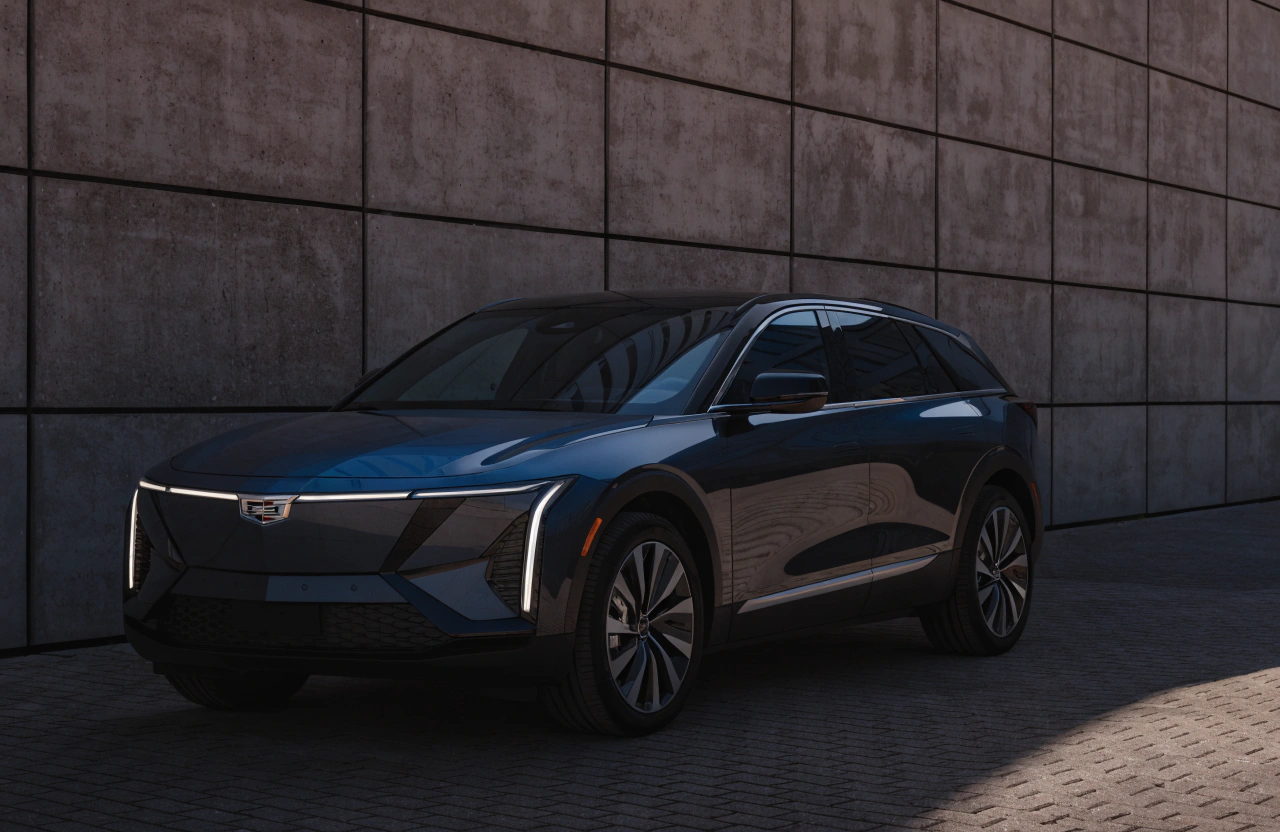
- Aesthetic Philosophy: Evolutionary for Cadillac, revolutionary for GM. It retains the sharp, vertical lighting signatures and Art & Science proportions but softens edges into a sleek, fastback SUV silhouette. The stance is confident, the proportion elegant, not aggressive.
- Manufacturing Rigor: This is the revelation. Panel gaps are consistent to within 0.5mm across hood, doors, and liftgate closures. The paint (our tester in Crystal White Tricoat) exhibited deep, orange-peel-free lamination. Doors close with a damped, vault-like thunk. The powered charge port door and flush-mounted door handles operate with jewel-like precision and silence. It meets or exceeds contemporary Audi/Mercedes standards.
2. Interior Sanctum: Material, Craft, and Space:
- Material Hierarchy: A forensic catalog reveals semi-aniline leather on seats and upper door panels, real open-pore Ashwood trim with metallic inlay, soft-touch synthetic suede on the headliner and pillars, and authentic machined aluminum for controls. Lower door cards and the deep footwells use a hard, but textured, plastic—the only cost-saving concession in an otherwise impeccable material geography.
- Ergonomic Truth: The driving position is superb, with a low dash and high seating providing a command view. The steering wheel, a thick-rimmed, hand-stitched wonder, adjusts perfectly. Physical controls are limited but critical: a crystal-like volume roller and physical buttons for climate temperature. The synergy is intuitive.
- Practicality Benchmarks: Cargo volume: 28.0 cubic feet behind rear seats, 60.8 cubic feet with seats folded. Rear-seat legroom: 39.6 inches. The space is vast, usable, and deeply luxurious. The frunk is a token 1.8 cubic feet, suitable for charging cables only.
3. The Digital Nervous System: Infotainment & Acoustics:
- Interface Inquisition: The 33-inch curved LED screen (9K resolution) is breathtaking in clarity. The underlying Google Built-In system is fast, logical, and benefits from native Google Maps and Assistant. Wireless Apple CarPlay/Android Auto are seamless. The critical win: Cadillac retains physical steering wheel buttons for core functions and the central climate panel. Haptic feedback on the steering wheel controls is precise, but the central climate slider is slightly less responsive.
- Audio Fidelity: The optional 19-speaker, 1400-watt AKG Studio Reference system is a benchmark. Clarity is stunning, with a wide, immersive soundstage. Bass is rich without being overpowering, and distortion is absent even at 90% volume. It lacks the outright visceral punch of the best Burmester or B&W systems but trades it for pristine accuracy.
D. The Driving Experience (The Heart of the Review)
The ultimate measure of a machine is its behavioral spectrum.
- Daily Epilogue (Tour Mode): Near-perfect isolation. Road noise is a distant murmur, wind noise suppressed to a whisper above 80 mph. The ride is cloud-like, dismissing broken urban asphalt. The steering is light, accurate, and devoid of feedback—perfect for parking lot maneuvers.
- Engagement Manifesto (Sport Mode): A noticeable transformation. Throttle mapping sharpens, damping firms by ~20%, and steering weight increases. Yet, it never feels truly sporty. The character shifts from “plush limousine” to “agile luxury cruiser.” Exhaust note is, of course, absent, replaced by a subtle, futuristic amplifier hum.
- Scenario Mastery:
- Urban Commute: Regenerative one-pedal driving makes it effortless. Visibility is good, though the thick rear pillars create a blind spot. The 360-degree camera is essential and crystal clear.
- Highway Transit: Its absolute forte. The Lyriq is preternaturally stable, tracking laser-straight with minimal driver input. This is the domain of Super Cruise (Version 1.3). The system, with its LiDAR-map-enabled, hands-free capability on 400,000+ miles of North American highways, is peerless. Lane changes initiated by the driver (via turn signal) are executed smoothly. It handles moderate curves with confidence. The driver attention monitor (using a corneal-tracking infrared camera) is unforgiving and correct—you must watch the road.
- Spirited Backroad: Competent, not captivating. Body roll is well-checked, and grip from the all-season tires is ample. The front-end turns in accurately, but steering feel is numb. The chassis feels massively capable but insulated from the driver. It devours a mountain road with serene, high-speed competence, not playful engagement.
E. The Verdict & Alternatives
- Pros:
- Super Cruise is the undisputed benchmark for stress-free highway travel.
- Build quality and material richness challenge the best in class.
- Serene, library-quiet ride quality and cruising refinement.
- Striking, cohesive design inside and out.
- Excellent real-world range (tested 290 miles in mixed conditions).
- Cons:
- Driving dynamics are isolated, lacking engagement for enthusiasts.
- Charging curve, while good, isn’t class-leading (peaks at 190 kW).
- Large blind spots over the shoulder.
- Over-reliance on capacitive touch for some secondary functions.
- Key Alternatives:
- BMW iX xDrive50: More dynamic, avant-garde interior, faster charging. Less intuitive tech, polarizing styling, and Super Cruise is more relaxing.
- Mercedes-Benz EQE SUV: Even more isolating ride, superior rear-seat luxury. Duller driving experience and frustrating hyperscreen interface.
- Genesis GV70 Electrified: Sharper value, more engaging drive. Less rear-seat space, less comprehensive driver-assist tech, brand cachet.
Final Call: The 2026 Cadillac Lyriq AWD is a watershed vehicle. It successfully executes a specific, highly desirable luxury brief: flawless long-distance comfort, impeccable build quality, and truly seamless technology. It is not the enthusiast’s choice, but for the discerning buyer who values tranquility, craftsmanship, and the best hands-free system on the planet, it is, unequivocally, the new benchmark.
THE AUTORANK’S SPEC BOX: THE CANONICAL DATA
- Powertrain: Dual Motor Ultium EV (Permanent Magnet Rear, Induction Front)
- Total Output: 500 hp / 450 lb-ft
- Transmission: Single-Speed Direct Drive
- Drivetrain: e-AWD
- Curb Weight: 5,640 lbs (2,558 kg)
- 0-60 mph (Manufacturer Claim): 4.8 sec
- 0-60 mph (As-Tested): 4.8 sec
- Top Speed: 125 mph (Governed)
- EPA Fuel Economy (Combined): 98 MPGe
- Real-World Observed Range: 290 miles
- Starting MSRP (USA, as tested): $74,790 / As-Tested: $85,185