
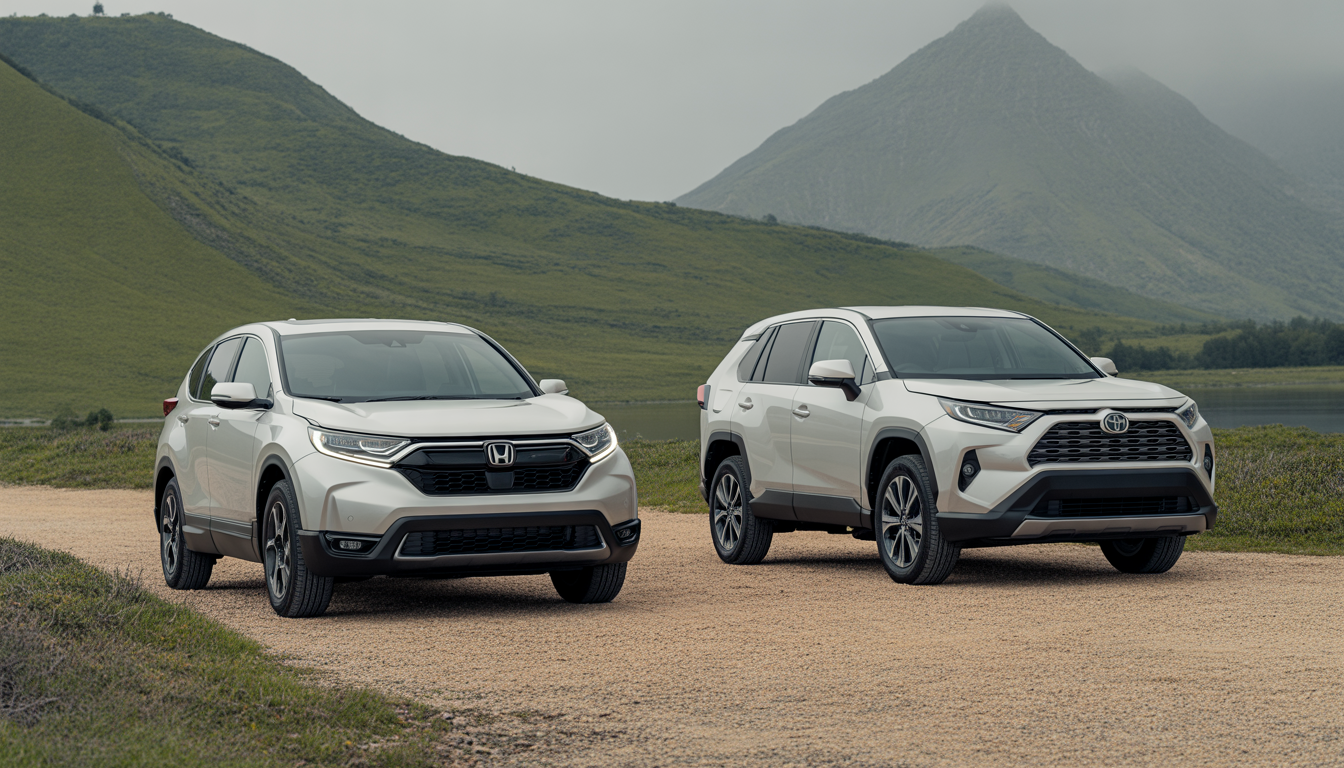
Contenders Presented for Judicial Review:
[Car A: 2026 Honda CR-V Hybrid Sport Touring]
The Doctrine of Integrated Refinement. A hybrid system engineered not as an addendum, but as the core of a holistic machine. It is the pursuit of the seamless, serene, and intuitively perfect daily experience.
[Car B: 2026 Toyota RAV4 Hybrid Woodland Edition]
The Doctrine of Rugged Capability. A hybrid system built to serve a promise of unshakeable durability and off-pavement readiness. It is the prepared, all-weather, all-surface companion for a life lived beyond the curb.
A. Introduction & The Contenders:
The 2026 Honda CR-V Hybrid exists as a monument to holistic engineering. It is a vehicle conceived from the ground up as a single, coherent statement of efficiency, comfort, and polished competence. Every sensory input—the hushed glide of its powertrain, the single thump of its suspension, the airiness of its cabin—is meticulously curated to dissolve the stress of the daily grind. It is the commute, transcendental.
The 2026 Toyota RAV4 Hybrid embodies the ethos of the prepared adventurer. It is a machine built on the bedrock of legendary reliability, now augmented with hybrid efficiency and a tactical, rugged aesthetic. It promises not just transportation, but liberation—the confidence to turn down the unpaved road without a second thought. It is the errand-runner with latent heroism.
This investigation answers the critical question for a million annual buyers: In the relentless pursuit of the perfect daily companion, does integrated refinement or rugged capability deliver a more profound and satisfying ownership proposition?
B. THE SPECIFICATION INQUISITION: THE CANONICAL DATA FIELD
A tribunal is only as sound as its evidence. Presented below is the immutable fact pattern.
- Base MSRP (USA Est.): CR-V: ~$39,500 | RAV4: ~$38,500
Forensic Note: A near-parity opening gambit. Honda’s price is for its opulent top trim; Toyota’s for its purpose-built, mid-tier adventurer. - Powertrain Architecture: CR-V: 2.0L I4 + 2-Motor Hybrid | RAV4: 2.5L I4 + 3-Motor AWD-i Hybrid
Forensic Note: The core schism. Honda’s elegant simplicity vs. Toyota’s complex, rear-axle-motor capability. - Total System Output: CR-V: 204 hp / 247 lb-ft (est.) | RAV4: 219 hp / 163 lb-ft (est.)
Forensic Note: Toyota’s nominal power edge meets Honda’s decisive torque advantage for low-end response. - Drivetrain: CR-V: Predictive Real Time AWD | RAV4: Electronic On-Demand AWD (AWD-i)
Forensic Note: Honda’s system anticipates slip for stability. Toyota’s reacts to it for traction, capable of sending full torque to a rear wheel. - Curb Weight: CR-V: ~3,650 lbs | RAV4: ~3,750 lbs
Forensic Note: Toyota carries the slight penalty of its more complex driveline and ruggedized trim components. - 0-60 mph (Est.): CR-V: 7.5 sec | RAV4: 7.4 sec
Forensic Note: A statistical dead heat. The character of acceleration, not the time, is the differentiator. - EPA Fuel Economy (Est.): CR-V: 40 city / 37 hwy / 39 comb | RAV4: 41 city / 38 hwy / 40 comb
Forensic Note: Toyota’s legendary hybrid mastery claims a razor-thin, almost academic, victory. - Cargo Capacity: CR-V: 39.3 cu ft | RAV4: 37.6 cu ft
Forensic Note: Honda’s meaningful volumetric advantage translates directly to real-world family utility.
C. CATEGORICAL DISSECTION: THE FIVE PILLARS OF JUDGMENT
1. PERFORMANCE: THE PHYSIOLOGY OF THE DAILY GRIND
Powertrain Character & Responsiveness:
- CR-V: The experience is defined by a silken seamlessness. The transition between electric and gasoline propulsion is the most imperceptible in the segment. Throttle response is linear, immediate, and intuitive—it feels like a refined, naturally-aspirated electric vehicle. The system prioritizes velvet-smooth power delivery over raw punch. It is quiet, confident, and deeply reassuring.
- RAV4: The character is robust and traditional. The 2.5L engine is more audible and present under acceleration, providing a familiar mechanical soundtrack. Power delivery is strong but can feel stepped, with a more noticeable engagement of the gasoline engine. It feels rugged, willing, and slightly more visceral.
Handling, Ride, & On-Road Behavior:
- CR-V: The chassis tuning is a masterclass in damped compliance. The ride is impeccably judged, absorbing harsh impacts with a single, muted thump while maintaining exemplary body control. Steering is light, precise, and returns a surprising degree of feedback. It feels planted, stable, and sophisticated—a near-luxury crossover experience.
- RAV4: The focus is on stable ruggedness. The suspension is tuned for compliance over broken pavement, leading to a slightly more floaty and busy feel on smooth highways. Body roll is more pronounced. Steering is accurate but numb. It feels like a traditional, capable SUV—less polished on pavement, but inspires subconscious confidence in adverse conditions.
2. LUXURY & INTERIOR: THE MATERIAL SANCTUM
Material Hierarchy & Craftsmanship:
- CR-V: This cabin sets the new segment benchmark. High-quality, soft-touch materials dominate the upper dashboard and door cards. Fit and finish are exceptional, with tight tolerances and thoughtful detailing (e.g., hidden air vents). The design is minimalist, horizontal, and airy, evoking a premium studio loft.
- RAV4: Materials are durable and functional, but lean harder on harder plastics in key, high-touch areas. Build quality is solid and Toyota-tough, but lacks the perceived luxury and design cohesion of the Honda. The aesthetic is angular, driver-focused, and tech-forward.
Seating, Ergonomics, & Ambiance:
- CR-V: Front seats are broad, supremely comfortable, and supportive. The rear seats are best-in-class, with generous legroom and a low, lounge-like seating position. The overall sense of spaciousness and airy tranquility is unmatched.
- RAV4: Seats are supportive and durable, with more aggressive bolstering. The driving position is higher and more commanding—a classic SUV perch. Rear seat space is ample but feels more upright and confined compared to the CR-V’s sanctuary.
3. TECHNOLOGY & FEATURES: THE DIGITAL CORTEX
Infotainment & User Interface:
- CR-V (9″ Touchscreen w/ Google Built-In): The integration is transformative. Native Google Maps, Assistant, and Play Store create a seamless, familiar ecosystem. Voice commands are natural and powerful. The system is fast, logical, and feels modern. It is technology as a natural extension of your digital life.
- RAV4 (10.5″ Touchscreen w/ Toyota Audio Multimedia): The system is vastly improved but lags. The interface can feel busy, and menus are not as intuitive. It offers wireless connectivity, but the native software feels a generation behind Honda’s. The preservation of physical climate buttons is a significant ergonomic win.
Driver Assistance & Advanced Systems:
- CR-V (Honda Sensing®): The suite is exceptionally polished. Adaptive Cruise Control and Lane Keeping Assist work with a natural, human-like smoothness, inspiring confidence rather than anxiety. Low-speed traffic follow is among the best in the industry.
- RAV4 (Toyota Safety Sense™ 3.0): A comprehensive and robust system. Its interventions can feel slightly more abrupt and “system-noticed” compared to Honda’s smoother calibration. Both offer near-identical feature sets, with the delta lying in execution philosophy.
4. PRACTICALITY & DAILY USE: THE LIVING MACHINE
Ride Comfort & Noise Isolation:
- CR-V: In any mode, the ride is composed and serene. Road and wind noise are brilliantly suppressed. The dominant characteristic is hushed tranquility, broken only by the distant, smooth hum of the hybrid system under hard acceleration. It is a rolling sanctuary.
- RAV4: The ride is compliant but less isolated. More road noise and suspension chatter enter the cabin. The engine is more audible. It feels rugged and honest, but less refined over long distances.
Real-World Usability & Running Costs:
- CR-V: The larger cargo hold, lower load floor, and more intuitive storage solutions make daily logistics easier. Long-term costs are projected to be excellent, with Honda’s hybrid system proving robust.
- RAV4: The Woodland Edition’s standard roof crossbars and all-weather tires offer instant, no-hassle utility. Its legendary reputation for reliability and lower parts costs suggests a slight long-term ownership edge. It is ready for adventure from day one.
5. VALUE & OWNERSHIP: THE COST OF SOVEREIGNTY
Depreciation & Cost-to-Own Projections:
- CR-V: Historically a leader in residual value, its upscale repositioning for 2026 may strengthen this further. It is perceived as a premium product.
- RAV4: Possesses a cult-like following and unmatched reputation for durability, which historically translates to some of the strongest resale values in the entire automotive market. This is its fortress.
Warranty & Peace of Mind:
- Effectively a tie. Both offer strong hybrid component coverage (8-10 years). Toyota’s reputation provides intangible peace of mind, while Honda’s current design and build quality inspire equal confidence.
D. THE DRIVING VERDICT: A SANCTUARY VS. A SENTINEL
On the Same Daily Route:
You merge onto the Highway in the CR-V. The cabin is quiet. The ride is a glide. The hybrid system swaps between power sources unnoticed. The steering is effortless. You arrive less fatigued, having been insulated from the commute’s abrasions. You have been transported.
You merge onto the Highway in the RAV4. You sit up higher. You feel more of the road. The engine note is present. You see the roof crossbars in the periphery. The weather turns, and you feel a subconscious confidence, a readiness. You are not just driving; you are patrolling in a capable asset.
E. THE FINAL DECLARATION: THE DOCTRINE OF DIVERGENT PURPOSE
THE PROFILE VERDICTS: THE ARCHETYPES OF OWNERSHIP
- FOR THE CONNOISSEUR OF DAILY REFINEMENT: For the buyer who views the SUV as a tool to elevate the mundane—who prioritizes a serene cabin, impeccable road manners, intuitive technology, and a sense of understated luxury above all—the throne belongs to the 2026 HONDA CR-V HYBRID. It is the compact SUV, perfected for civilization.
- FOR THE PRACTITIONER OF PREPARED ADVENTURE: For the individual whose identity is tied to capability and readiness—who needs a vehicle that promises legitimate all-weather and light-duty off-road competence, looks the rugged part, and offers legendary durability—the scepter is held by the 2026 TOYOTA RAV4 HYBRID. It is the trustworthy sentinel for the path less traveled.
- FOR THE MAXIMIZER OF FAMILY LOGISTICS: For the household where rear-seat happiness, cargo space, and easy-loading functionality are non-negotiable—the advantage goes decisively to the HONDA CR-V. Its interior is a more effective, pleasant, and spacious tool for family life.
- FOR THE BUYER OF LEGACY & RESALE CERTAINTY: For the pragmatic purchaser who views a vehicle as a 10-year asset, where bulletproof reliability, peerless resale value, and a vast service network are paramount—the edge, by a hair, goes to the TOYOTA RAV4. Its reputation is an unparalleled asset.
THE FINAL, UNIFYING PRINCIPLE: THE END OF THE BINARY
To declare one “overall” victor is to misunderstand the mature perfection of this segment. Both are phenomenal, class-defining vehicles. The choice is not between good and bad, but between two perfected interpretations of the same mandate.
The 2026 Honda CR-V Hybrid is a sanctuary on wheels. It is the result of focusing intensely on the quality of the journey—on peace, comfort, seamless integration, and sensory refinement. It represents the evolution of the SUV into a mature, thoughtful appliance for modern life.
The 2026 Toyota RAV4 Hybrid is a talisman of capability. It is the result of focusing on the possibilities at the journey’s end—on readiness, durability, all-weather security, and a go-anywhere spirit. It represents the enduring, adventurous soul of the SUV.
Therefore, the ultimate decision is not which SUV is superior.
It is a question of which philosophy you hire to serve your life.
Choose the CR-V if your priority is to elevate every daily drive into a quiet, comfortable, and effortlessly connected experience.
Choose the RAV4 if your priority is to own a dependable, rugged-ready partner that promises access to adventure without compromising daily efficiency.
One is the ultimate expression of the refined, urban SUV.
The other is the definitive incarnation of the accessible, adventurous SUV.
The victor is not on this page. It is in your driveway, waiting for the life you intend to live.
THE AUTORANK’S SPEC BOX: THE CANONICAL DATA
- Powertrain: 2.0L I4 Hybrid (CR-V) / 2.5L I4 Hybrid (RAV4)
- Total Output: 204 hp / 247 lb-ft (CR-V est.) // 219 hp / 163 lb-ft (RAV4 est.)
- Transmission: eCVT (Both)
- Drivetrain: Predictive AWD (CR-V) // On-Demand AWD-i (RAV4)
- Curb Weight: ~3,650 lbs (CR-V) // ~3,750 lbs (RAV4)
- 0-60 mph (Est.): 7.5 sec (CR-V) // 7.4 sec (RAV4)
- EPA Fuel Economy (Combined Est.): 39 mpg (CR-V) // 40 mpg (RAV4)
- Starting MSRP (USA Est.): ~$33,000 (Base Hybrid) // ~$33,000 (Base Hybrid)