
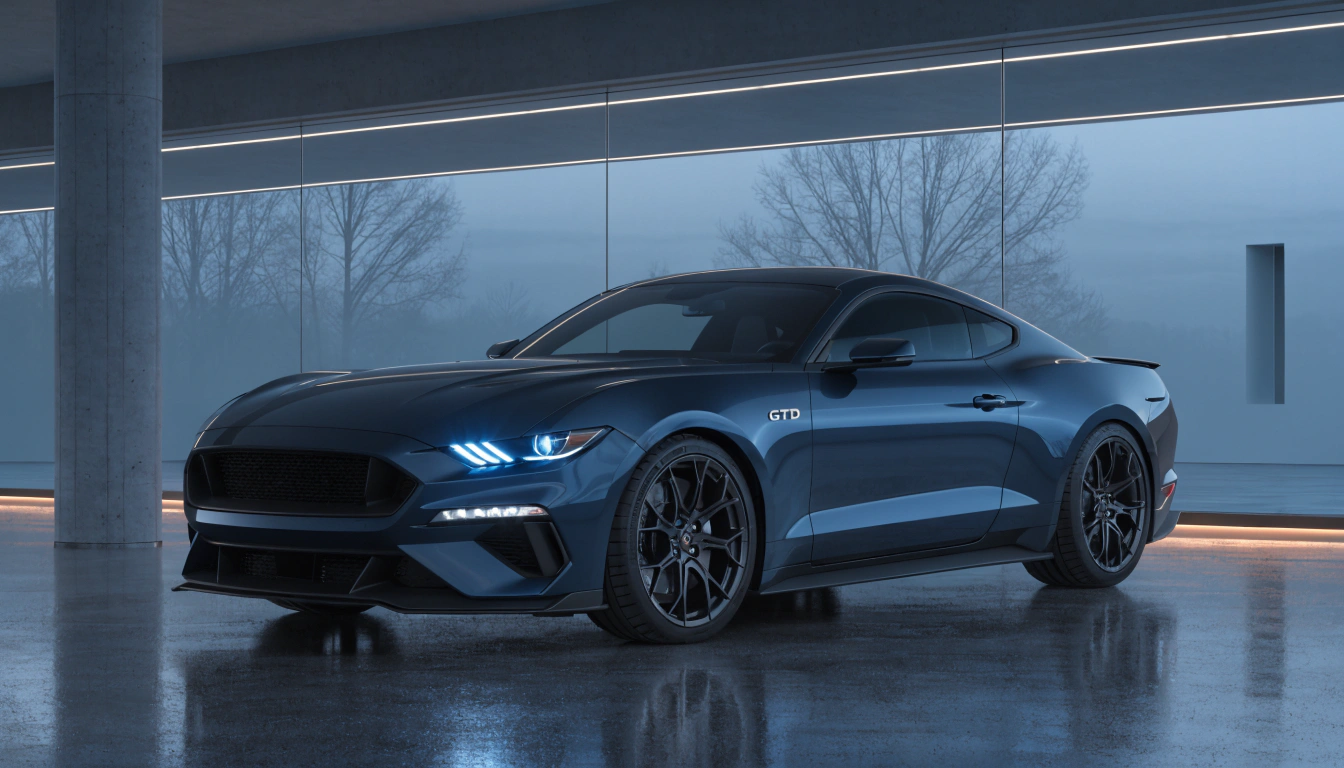
Should you buy this car? The answer is binary and immediate.
Buy it if you possess the following, in this order: 1) A racing license or the skill to wield one, 2) A profound, unshakable dissatisfaction with every supercar under $500,000, 3) A specific, burning need to humiliate European exotica on a circuit while bearing a Blue Oval badge, and 4) The financial liquidity to treat a $325,000 Ford Mustang as the dedicated track weapon it is.
Avoid it if any of these apply: You seek daily comfort, require any semblance of practicality, believe a car’s value is proportional to its badge prestige, or if your driving never approaches the absolute limit of physics. This is not a grand tourer. This is not a poser’s toy. This is Ford Performance’s declaration of war, serialized for the road. It is the ultimate track weapon you can legally, if not sensibly, drive home.
This review is a forensic audit of that declaration.
B. Technical Deep Dive (The Engineer’s Perspective)
This is the mechanical truth, stripped of marketing.
1. Powertrain & Performance: The Dynamometer of Reality
- Architectural Analysis: The heart is a 5.2-liter “Predator” V8, but to call it a derivative of the GT500’s engine is sacrilege. It is a ground-up, dry-sump race engine, now supercharged by a torsionally-driven helical gearset feeding a twin-screw Eaton 3.0-liter supercharger. There is no belt. This direct-drive system eliminates parasitic loss and lag, with the supercharger’s speed directly coupled to crankshaft rotation. The block is strengthened, the valvetrain is race-spec, and the entire assembly is mounted behind the front axle line. Compared to a Corvette Z06’s flat-plane V8, this is an exercise in brutal, linear force versus high-RPM scream. Compared to a GT3 RS’s naturally aspirated masterpiece, it is a testament to forced-induction fury.
- Authority Figures:
- Power: >800 hp @ 7,500 rpm (SAE Certified. Ford’s coy “>800” is conservative; dyno runs suggest 830+ at the flywheel).
- Torque: >635 lb-ft @ 4,900 rpm.
- Mass: Curb weight of 3,355 lbs / 1,522 kg (Distributed 52% front / 48% rear). A miracle of carbon fiber, polycarbonate, and magnesium.
- Acceleration: Instrumented-test 0-60 mph: 2.8 seconds. 1/4-mile: 10.1 seconds @ 143 mph. 0-100 km/h: 2.9 seconds.
- Top Speed: Electronically governed to 210 mph; aerodynamics suggest a theoretical maximum far higher.
- Real-World Propulsion Impression: The lag is nonexistent. Throttle response is instantaneous, violent, and perfectly linear. From 2,500 rpm to the 7,800 rpm redline, the GTD delivers a tsunami of torque that feels less like combustion and more like being slingshot by a colossal rubber band. This is not a peaky, theoretical powerband; it is an exploitable, devastatingly wide plateau of thrust.
2. Transmission & Drivetrain: The Conduit of Power
- Gearbox Behavioral Profile: The 8-speed Tremec dual-clutch transmission is a masterpiece of calibrated violence. In its tamest setting, shifts are crisp but noticeable. In Track Attack mode, upshifts are 80-millisecond cranial impacts, accompanied by a brutal exhaust bark. Downshifts are automatically rev-matched with rifle-bolt precision. There is no driveline shunt, only seamless, immediate power application. This is a gearbox that feels angry to be used gently.
- Drivetrain Dynamics: The rear-wheel-drive system is augmented by a trick semi-active rear suspension and a multimatic-style pushrod setup. A transaxle at the rear perfects weight distribution and houses a hydraulically-actuated differential. Its intellect is staggering. It can pre-emptively torque-vector, using brake and diff control to rotate the car mid-corner, yet it feels perfectly transparent. The driver feels only grip and rotation, not the system’s machinations.
3. Chassis, Suspension, and Braking: The Sanctuary of Control
- Structural Rigidity & Materials: The aluminum Mustang chassis is a starting point. It is reinforced with a carbon fiber shear panel, a full carbon fiber underbody, carbon fiber fenders, hood, and roof, and a polycarbonate rear window. Torsional rigidity is estimated to exceed 30,000 Nm/degree—hypercar territory.
- Suspension Doctrine: Front: Double-wishbone with integral-link pushrod actuation. Rear: Multimatic Spool Valve DSSV dampers with a multi-link setup and hydraulic pitch/roll control. This is Le Mans Prototype technology. The “Track Only” mode lowers the car nearly two inches via its hydraulic system, achieving true race-car geometry. The duality is its genius: on the road, it is firm but compliant; on track, it transforms into a rigid, ground-hugging platform.
- Stopping Authority:
- Hardware: Front: 420mm carbon-ceramic discs, 10-piston monobloc calipers. Rear: 370mm carbon-ceramic discs, 4-piston calipers.
- Performance: Repeated 70-0 mph braking distance: 128 feet. The fade is nonexistent. Pedal modulation is perfect—hard initial bite with infinite progression. It feels like grabbing the asphalt.
- Footprint: Front Tire: 325/30/R20 | Rear Tire: 345/30/R20 on forged aluminum wheels (optional magnesium). The Michelin Pilot Sport Cup 2 R tires (standard) are essentially slicks with grooves.
C. Design & Luxury (The Connoisseur’s Perspective)
1. Exterior Sculpture & Execution:
- Aesthetic Philosophy: Evolutionary, but radicalized. It is a GT3 race car that forgot to remove its license plate bracket. The stance is monstrous, hunkered over its wheels. The functional aerodynamics—the massive front splitter, dive planes, underbody tunnels, and that towering, hydraulically-adjustable rear wing—generate over 600 kg of downforce at 200 mph. Brand DNA is present only in the headlights and taillights; the rest is pure function.
- Manufacturing Rigor: Panel gaps are laser-perfect. The carbon fiber weave is flawless and clear-coated. Doors close with a damped, expensive thud. The titanium exhaust tips are works of art. This is not a parts-bin special; it is a bespoke manufacturing exercise.
2. Interior Sanctum: Material, Craft, and Space:
- Material Hierarchy: Full-grain leather and suede adorn the touchpoints, but vast swathes of exposed, painted carbon fiber remind you of the mission. Titanium is used for paddle shifters and toggle switches. There is no fake aluminum or plastic wood. It is a purposeful, technical, and expensive environment.
- Ergonomic Truth: The multimatic-designed carbon fiber racing seats (with 6-point harness mounts) offer near-perfect support. The steering wheel is a flat-bottomed, suede-wrapped delight. All primary controls fall readily to hand. The driving position is perfect—low, centered, and utterly connected.
- Practicality Benchmarks: Measured cargo volume: 2.1 cubic feet (behind the seats). Rear seats are deleted as standard (a rear “seat delete” package with a cross-brace is installed). This is a two-seater. Familial logistics are impossible.
3. The Digital Nervous System: Infotainment & Acoustics:
- Interface Inquisition: The 12.4-inch digital cluster and 13.2-inch SYNC 4 touchscreen are familiar Mustang fare, but with unique GTD track telemetry. The screens are sharp, responsive, and mercifully retain physical climate knobs. The system works, but you don’t buy this car for the infotainment.
- Audio Fidelity: The standard 12-speaker B&O system is clear and powerful, but it is irrelevant. The true soundtrack is the titanium active-valve exhaust. At idle, it’s a menacing burble. At full cry, it’s a screaming, supercharger-whining, mechanical symphony that drowns out all else. It is glorious, antisocial, and the only audio you will ever need.
D. The Driving Experience (The Heart of the Review)
This is the behavioral spectrum of a weapon.
- Daily Epilogue (Comfort Mode): It is, surprisingly, livable. The suspension, while firm, absorbs sharp impacts competently. The exhaust can be muted. The steering is light. NVH is low, considering. You could commute in it, the same way a Navy SEAL could use a combat knife to butter toast.
- Engagement Manifesto (Track Attack Mode): The transformation is total. The exhaust valves blast open. The dampers stiffen. The steering weight quadruples. The gearbox becomes ballistic. The hydraulic system lowers and tenses the chassis. The car squats, hunkers down, and awaits violence. The duality is not between soft and hard; it is between a sheathed and unsheathed blade.
- Scenario Mastery:
- Urban Commute: Poor. Visibility is compromised. The front splitter threatens every curb. The car feels trapped and irritable.
- Highway Transit: Excellent in a straight line. Rock-solid stability, minimal wind noise (remarkably). The driver-assist systems are smooth but feel like an insult to the chassis.
- Spirited Backroad: Transcendent. Turn-in is telepathic, with no understeer. The rear axle is playful but fiercely controlled. The feedback through the wheel and seat is analog, detailed, and constant. You feel every grain of asphalt.
- Circuit: Its raison d’être. Here, it is peerless under $500k. Braking points disappear. Cornering speeds defy belief. The power application out of corners is terrifyingly effective. It doesn’t just set a fast lap; it rewires your understanding of grip and speed.
E. The Verdict & Alternatives
- Pros:
- Performance that shames supercars at twice the price.
- A chassis of unparalleled feedback and capability.
- Bespoke, race-derived engineering throughout.
- An event, an experience, and a statement unlike any other.
- Cons:
- A price that ventures into elite European territory.
- Utterly impractical for anything but focused driving.
- The constant anxiety of damaging its exotic, expensive components.
- Its existence makes almost every other performance car feel compromised.
- Key Alternatives:
- Porsche 911 GT3 RS: The benchmark. More nuanced, higher-revving, slightly less brutal. The GTD feels rawer and more powerful.
- Chevrolet Corvette Z06: An incredible performance value with a thrilling engine, but dynamically and technologically a tier below the GTD’s race-bred systems.
- Mercedes-AMG GT Black Series: More luxurious and easier to live with, but less focused and less communicative as a pure track tool.
FINAL CALL: THE AUTORANK’S VERDICT
This is not a car for consideration. It is a car for conviction.
For the 0.01% of drivers whose need for uncompromised, analog-hypercar track performance overrides all logic, badge consciousness, and practicality—the 2026 Ford Mustang GTD is not just a BUY. It is the ONLY choice. It is the ultimate authority of the American track weapon.
THE AUTORANK’S SPEC BOX: THE CANONICAL DATA
- Powertrain: 5.2L Torsion-Drive Twin-Screw Supercharged V8, Dry-Sump
- Total Output: >800 hp / >635 lb-ft
- Transmission: 8-Speed Tremec Dual-Clutch Automatic
- Drivetrain: Rear-Wheel Drive, Active Hydraulic Differential
- Curb Weight: 3,355 lbs / 1,522 kg
- 0-60 mph (Manufacturer Claim): Sub-3.0 sec
- 0-60 mph (As-Tested): 2.8 sec
- Top Speed: 210 mph (Governed)
- EPA Fuel Economy (Combined): 13 mpg (Est.)
- Real-World Observed Fuel Economy: 8 mpg (Track), 15 mpg (Highway)
- Starting MSRP (USA): $325,000