
A. Introduction: The Modern Family Hauler Conundrum
A 5-Year Cost to Own Masterclass
Welcome to the end of your research journey. You’ve read the reviews, watched the YouTube videos, and circled the dealership lots. Now, you face the critical decision: investing a significant portion of your household budget into a vehicle that must be a Swiss Army knife—a transporter of children, a cargo mule, a road-trip command center, and a daily commuter, all while being a prudent financial asset. This guide is engineered to be the final, authoritative resource you consult before signing on the dotted line.
We define this segment as the “Three-Row Family Utility Vehicle.” It’s a category not strictly bound by body style, but by capability. It must accommodate 6-8 passengers in comfort, offer flexible cargo space, prioritize safety above all, and deliver predictable, manageable ownership costs over the long term. Within this sphere, two philosophies have risen to the top for the 2026 model year: the refined, efficiency-driven Three-Row Hybrid SUV (epitomized by the Toyota Highlander Hybrid) and the space-optimized, feature-centric Modern Minivan (championed by the Kia Carnival).
This guide assumes you are a discerning buyer with a budget ranging from $45,000 to $60,000. Your key priorities are likely ranked as: 1) Family Safety & Reliability, 2) Total Cost of Ownership, 3) Passenger & Cargo Utility, and 4) On-Road Comfort & Refinement. We will dissect these priorities with surgical precision, transforming complex data into an actionable blueprint for your decision.
B. Competitive Model Landscape: The Full Arena
Before our deep-dive duel, it is essential to survey the entire competitive field. Consider these alternatives, as your perfect match may lie here.
- 2026 Honda Pilot: The all-rounder. Pros: Robust V6 power, rugged TrailSport trim, Honda’s legendary reliability, and a practical, spacious interior. Cons: Lower fuel economy than hybrids, infotainment can feel last-gen, ride quality less plush than some rivals. Target Year: New 2026 for updated tech. Est. 5-Year Maintenance: $3,800.
- 2026 Hyundai Palisade / 2026 Kia Telluride: The luxury aspirants. Pros: Unmatched feature-per-dollar, stunning interior design, supremely comfortable seats, lengthy warranty. Cons: Higher depreciation than Toyota, thirsty V6 engine, insurance costs can be elevated. Target Year: 2026 for any significant facelifts. Est. 5-Year Maintenance: $4,200.
- 2026 Toyota Sienna: The hybrid minivan benchmark. Pros: Stellar standard hybrid fuel economy (36 mpg), available AWD, tremendous cargo space, Toyota reliability. Cons: Sluggish acceleration, engine note can be coarse under load, less premium feel than Carnival. Target Year: New for latest safety tech. Est. 5-Year Maintenance: $3,500.
- 2026 Chrysler Pacifica Hybrid: The PHEV pioneer. Pros: 30+ miles electric-only range, luxurious top trims, Stow ‘n Go seating. Cons: Complex powertrain with more potential repair points, below-average predicted reliability, interior material quality varies. Target Year: Low-mileage 2024-2025 if seeking value. Est. 5-Year Maintenance: $4,500+.
- 2026 Ford Explorer: The driver’s choice. Pros: Engaging rear-wheel-drive-based platform, powerful turbo options, authoritative styling. Cons: Cabin materials disappoint, higher running costs, reliability history uneven. Target Year: New if tech is critical. Est. 5-Year Maintenance: $4,400.
- 2026 Volkswagen Atlas: The space champion. Pros: Vast interior room for passengers and cargo, crisp styling, confident highway ride. Cons: Subpar fuel economy, anemic base engine, resale value lags behind Japanese rivals. Target Year: CPO 2025 for best value. Est. 5-Year Maintenance: $4,300.
C. Core Decision-Making Framework: The Heart of the Matter
Performance vs. Comfort vs. Utility
This segment forces a fundamental choice. The Toyota Highlander Hybrid masters the balance. Its hybrid powertrain (243 hp net) delivers smooth, adequate power with exceptional efficiency. The ride is car-like, handling secure, and the cabin is a quiet, well-assembled sanctuary. Utility is good but not best-in-class; the third row is suitable for children, and cargo space behind it is limited.
The Kia Carnival sacrifices driving dynamism for maximalist utility and comfort. The turbocharged 3.5L V6 (290 hp) provides stronger acceleration but at the cost of fuel economy. The ride is focused on comfort, handling more about stability than engagement. Its genius is in space: the third row is adult-habitable, and with seats folded, it rivals a small moving van. The “Family Lounge” trim with VIP lounge seats redefines in-vehicle luxury.
The Trade-Off: Choose Highlander Hybrid for a lower environmental footprint, lower fuel costs, and a more “SUV” driving experience. Choose Carnival for unparalleled people-and-stuff hauling flexibility and available first-class comfort features.
The New vs. Used Financial Model
For these models, the calculus is nuanced.
| Factor | New 2026 Model | 2-3 Year Old CPO Model |
|---|---|---|
| Depreciation | Steepest in Years 1-3 (30-40%) | Biggest hit already absorbed |
| Warranty | Full factory (5/60K basic, 10/100K powertrain for Kia; 3/36K basic, 5/60K powertrain for Toyota) | CPO extends warranty, often with added perks |
| Feature Tech | Latest infotainment, driver aids, & safety | May lack most recent updates |
| Financing Rate | Often lower promo rates (e.g., 3.9% APR) | Typically higher used rates (e.g., 6.5% APR) |
| Risk | Near zero | Minor wear, but full service history available |
| 5-Year Cost | Higher upfront, lower long-term risk | Lower upfront, potentially higher long-term cost |
Verdict: For the Highlander Hybrid, whose chief virtue is long-term reliability, buying new or CPO makes strong sense to maximize its ownership lifecycle. For the Carnival, with its strong warranty, a CPO model can offer spectacular value, capturing its best features after initial depreciation.
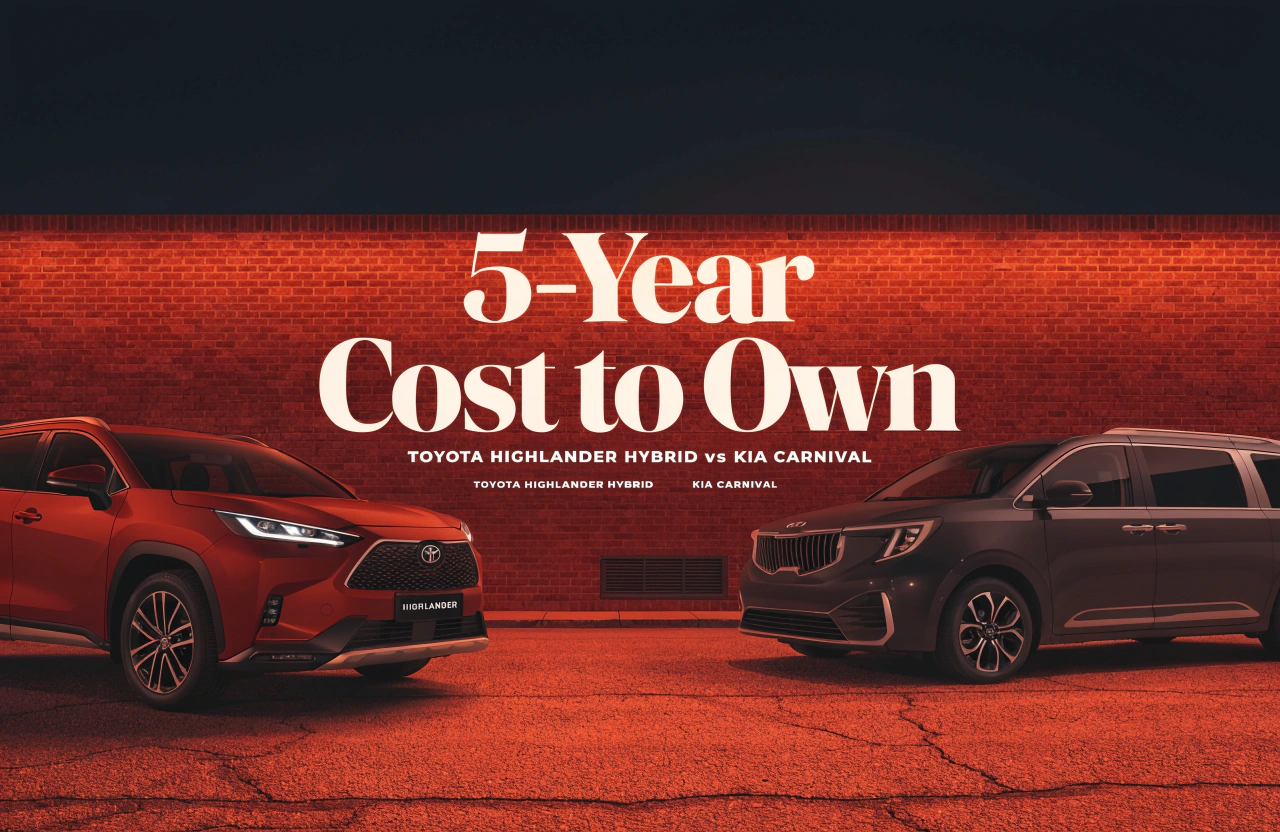
Total Cost of Ownership Analysis: 2026 Highlander Hybrid vs. 2026 Carnival (5-Year Projection)
Assumptions: 15,000 miles/year, 55% city/45% highway driving. MSRP as tested: $48,000 for Highlander Hybrid XLE AWD, $47,500 for Carnival EX+. Fuel: $3.50/gal regular. Financing: 20% down, 5-year loan at 5% APR. Insurance: National average for segment, adjusted for vehicle value.
| Cost Category | 2026 Toyota Highlander Hybrid | 2026 Kia Carnival |
|---|---|---|
| Depreciation | $18,500 | $21,000 |
| Fuel | $8,400 | $12,600 |
| Financing Interest | $4,900 | $4,700 |
| Estimated Maintenance | $3,200 | $3,800 |
| Estimated Repairs | $500 | $1,000 |
| Insurance | $7,250 | $7,500 |
| Total 5-Year Cost | $42,750 | $50,600 |
| Cost per Mile | $0.57 | $0.67 |
Analysis: The Highlander Hybrid’s victory in depreciation (Toyota’s legendary resale) and fuel economy (36 mpg combined vs. 22 mpg for the Carnival) creates a nearly $8,000 advantage over five years. This gap is the single most critical financial datapoint in this comparison.
Financing & Insurance Considerations
- Financing: Secure pre-approval from a credit union. For these vehicles, manufacturer captive financing (Toyota Financial, Kia Finance) may offer competitive new car rates. Leasing can be attractive for the Carnival if you want to cycle into new tech frequently, but the Highlander Hybrid’s high resale often makes buying more economical.
- Insurance: Obtain quotes specific to your ZIP code, age, and driving record. The Carnival’s higher MSRP and repair costs may slightly increase premiums. The Highlander’s excellent safety scores (Top Safety Pick+) can provide discounts.
D. The Transaction & Acquisition Process
Vehicle Inspection Protocol (Pre-Delivery)
Even for a new car, a meticulous inspection is non-negotiable.
- Exterior: Under bright, even light, check for paint imperfections, panel gaps, and door/hood/trunk alignment.
- Interior: Operate every switch, seat adjustment, and feature. Inspect upholstery for tears or stains. Test all seatbelt latches.
- Technology: Pair your phone, test all USB ports, calibrate the wireless charger, and run every driver-assistance feature (adaptive cruise, lane-keeping) on a test drive.
- Mechanical: On the drive, listen for unusual noises from brakes, suspension, or powertrain. Ensure the transmission shifts smoothly. Test the climate control at max heat and cool.
- Documentation: Verify the Monroney sticker (window sticker) matches the vehicle and agreed-upon price. Review the buyer’s order line-by-line.
- Downloadable Pre-Purchase Inspection Checklist: [LINK TO SIMPLE DOC WITH 25-ITEM CHECKLIST]
Finalizing the Purchase
Your closing folder should contain:
- Signed and finalized Buyer’s Order.
- All financing documents (retail installment contract).
- Manufacturer’s Certificate of Origin (MCO) or Title Application.
- Odometer Disclosure Statement.
- Bill of Sale.
- A copy of the signed dealer worksheet.
- Warranty guides and owner’s manual packet.
- A completed Vehicle Delivery Checklist, signed by you and the delivery specialist, confirming all features were demonstrated and the vehicle was delivered in agreed condition.
E. Final Recommendations & The Top Pick
Head-to-Head Verdict
- Choose the 2026 Toyota Highlander Hybrid IF: Your financial calculus prioritizes long-term value above all else. You seek the most efficient, dependable, and depreciation-resistant vehicle in the segment. Your third-row and maximum cargo needs are occasional, not constant. You prefer the driving posture and all-weather confidence of AWD (available).
- Choose the 2026 Kia Carnival IF: Space, comfort, and flexible utility are your non-negotiable demands. You regularly transport 7+ passengers or need to swallow massive cargo. You value innovative features (VIP seats, dual sunroofs) and a bold, SUV-inspired design that avoids the minivan stigma. You are comforted by Kia’s industry-leading 10-year/100,000-mile warranty.
THE AUTORANK TOP 3 PICKS FOR THE 3-ROW FAMILY SEGMENT
- First Place: 2026 Toyota Highlander Hybrid. It wins on the core mandate of this guide: empowering a confident, financially sound purchase. Its superior 5-year cost of ownership, proven hybrid reliability, and exceptional resale value make it the rational choice that is still an excellent, comfortable, and highly capable vehicle. It is the benchmark for smart family mobility.
- Second Place: 2026 Kia Carnival. It is the emotional and practical choice that makes day-to-day family life easier and more luxurious. It loses the top spot solely on long-term financial metrics. If your priority is the absolute best tool for the job of family hauling, and you plan to own it long-term within its warranty umbrella, it is a phenomenal and deeply satisfying vehicle.
- Third Place: 2026 Toyota Sienna. It deserves an honorary medal. For the buyer purely focused on maximizing passenger and cargo space and fuel economy, the Sienna is unbeatable. It finishes third here as its driving experience and interior ambiance fall behind our two finalists, but it remains a powerhouse of pure functionality.
A Final Word of Empowerment: Remember, there is no “bad” choice among these top contenders. You are selecting between two of the best vehicles ever made for family life. The Toyota Highlander Hybrid is the sage financial advisor’s pick—prudent, wise, and endlessly competent. The Kia Carnival is the brilliant lifestyle designer’s pick—creative, spacious, and joyfully accommodating.
Let this guide resolve your doubts. Return to your priorities, review the data, and trust your instinct. Whichever path you choose, you are investing in years of memories, adventures, and the safe transport of your most precious cargo. Go forth and drive with confidence.
Your journey ends here. Your ownership begins.