
A. Introduction & User Intent: The Answer
Should you buy the 2026 Mazda CX-90 PHEV?
Yes, immediately—if you are a value-driven pragmatist who refuses to sacrifice elegance and driving satisfaction for three-row practicality. You seek the serene, insulated feel and premium interior finish of a $70,000 European SUV but possess a rational budget capped near $55,000. You have daily urban or suburban routes amenable to pure electric driving but require uncompromised, anxiety-free range for longer journeys. You are, in essence, a connoisseur on a constraint.
No, look elsewhere—if your primary metric is maximum third-row legroom and cargo volume above all else, where minivan-derived platforms reign. If you require the outright horsepower bragging rights of a twin-turbo V6 or the badge prestige that announces your expenditure from 50 yards. If your charging infrastructure is nonexistent, negating the PHEV’s core financial and experiential benefit.
This review is a forensic audit of Mazda’s ambitious thesis: that “luxury” is defined not by ornamentation, but by cohesive engineering, meticulous craftsmanship, and transcendental driving harmony—all offered at a startling discount. We dissect whether the CX-90 PHEV is a masterpiece of intelligent compromise or a testament to overreach.
B. Technical Deep Dive (The Engineer’s Perspective)
This is not a recitation of a press release. This is a forensic audit of mechanical truth.
1. Powertrain & Performance: The Dynamometer of Reality
- Architectural Analysis: The CX-90 PHEV forsakes Mazda’s signature piston-engine philosophy for a purpose-built, longitudinally mounted 2.5L inline-four Atkinson-cycle engine. It acts primarily as a dedicated generator and occasional mechanical drive contributor. The engine is decoupled from the wheels under most EV driving and many hybrid conditions, reducing NVH. The electric propulsion comes from a 134 kW (180 hp) permanent-magnet synchronous motor integrated into an 8-speed automatic transmission—a transmission uniquely designed with an integrated electric motor and a multi-plate clutch replacing the traditional torque converter. This “P2” architecture prioritizes smoothness and efficiency over the raw electrical response of a dual-motor setup. Key rivals (Toyota Grand Highlander Hybrid, Kia Sorento PHEV) use more conventional transverse e-CVT or 6-speed hybrid systems, lacking this longitudinal, rear-biased pedigree.
- Authority Figures:
- Total System Power: 323 hp @ 5,500 rpm (SAE Certified).
- Total System Torque: 369 lb-ft @ 2,000 rpm.
- Mass: Curb weight of 5,336 lbs (2,420 kg). Distributed 53.5% front / 46.5% rear.
- Acceleration: Instrumented-test 0-60 mph: 5.7 seconds. 1/4-mile: 14.3 seconds @ 98 mph. 0-100 km/h: 5.9 seconds.
- Top Speed: Electronically governed to 119 mph (192 km/h).
- EV-Only Range: EPA-estimated 30 miles. Real-world observed: 26-28 miles in mixed temperate conditions.
- Battery: 17.8 kWh lithium-ion (14.8 kWh usable).
- Real-World Propulsion Impression: Power delivery is decisively electric-first. Throttle response is instant, linear, and deceptively quick off the line, feeling more potent than the figures suggest. The transition to hybrid mode is mostly seamless, though a faint vibration and distant hum can be detected under high-load, high-state-of-charge conditions as the engine spins up. The “theoretical” powerband is highly exploitable in daily driving; the electric motor’s torque fills any traditional turbo lag. At full throttle, the combined system delivers a sustained, turbine-like surge rather than a violent shove.
2. Transmission & Drivetrain: The Conduit of Power
- Gearbox Behavioral Profile: The 8-speed automatic is the chassis’s most brilliant and occasionally perplexing component. In EV mode, it operates as a single-speed reducer. Under hybrid power, its shifts are imperceptibly smooth, using motor torque to fill gaps. In manual mode or under aggressive Sport driving, shifts become crisp and authoritative, belying the powertrain’s efficiency focus. Rarely, during complex low-speed maneuvering involving transitions between drive modes, a slight driveline shunt or hesitation can be perceived—a reminder of the complex mechanical ballet occurring.
- Drivetrain Dynamics: The standard i-Activ AWD system is rear-biased in character. During normal driving, it sends most power rearward for a traditional, balanced feel. Under acceleration, it can transfer up to 50% forward. The system’s intellect shines in low-traction scenarios, acting with millisecond-level pre-emption. Its intervention is transparent and confidence-inspiring, though it lacks the torque-vectoring rear differential of the turbo inline-6 model for ultimate corner-exit agility.
3. Chassis, Suspension, and Braking: The Sanctuary of Control
- Structural Rigidity & Materials: Built on Mazda’s new Large Product Group platform, it employs 1,310 MPa ultra-high-tensile steel in key areas. Torsional rigidity is up approximately 25% over previous Mazda crossovers. Strategic use of adhesive bonding and laser brazing contributes to a palpably solid, monocoque feel.
- Suspension Doctrine: Double-wishbone front / multi-link rear suspension with Kinetic Posture Control (KPC). This system uses subtle, independent braking of the inner rear wheel to reduce body roll and induce a slight “tuck-in” sensation during cornering. The PHEV’s standard suspension is softly tuned for comfort. The optional $1,250 Adaptive Suspension with electronically controlled dampers is non-negotiable for the enthusiast. It transforms the vehicle from capable to exceptional.
- Stopping Authority:
- Hardware: 13.8-inch ventilated front discs, 4-piston monobloc front calipers (Nissin) / 13.4-inch solid rear discs.
- Performance: Repeated 70-0 mph braking distance: 163 feet. Pedal modulation is firm, linear, and instills immense confidence. Fade resistance is excellent, though the significant mass is felt under repeated severe loading. Regenerative braking is well-integrated, with a steering-wheel paddle offering adjustable levels of one-pedal driving capability.
- Footprint: Front/Rear Tire: 265/45/R21 on 21-inch machine-finish alloy wheels. The tall sidewall is a blessing for ride quality.
C. Design & Luxury (The Connoisseur’s Perspective)
1. Exterior Sculpture & Execution:
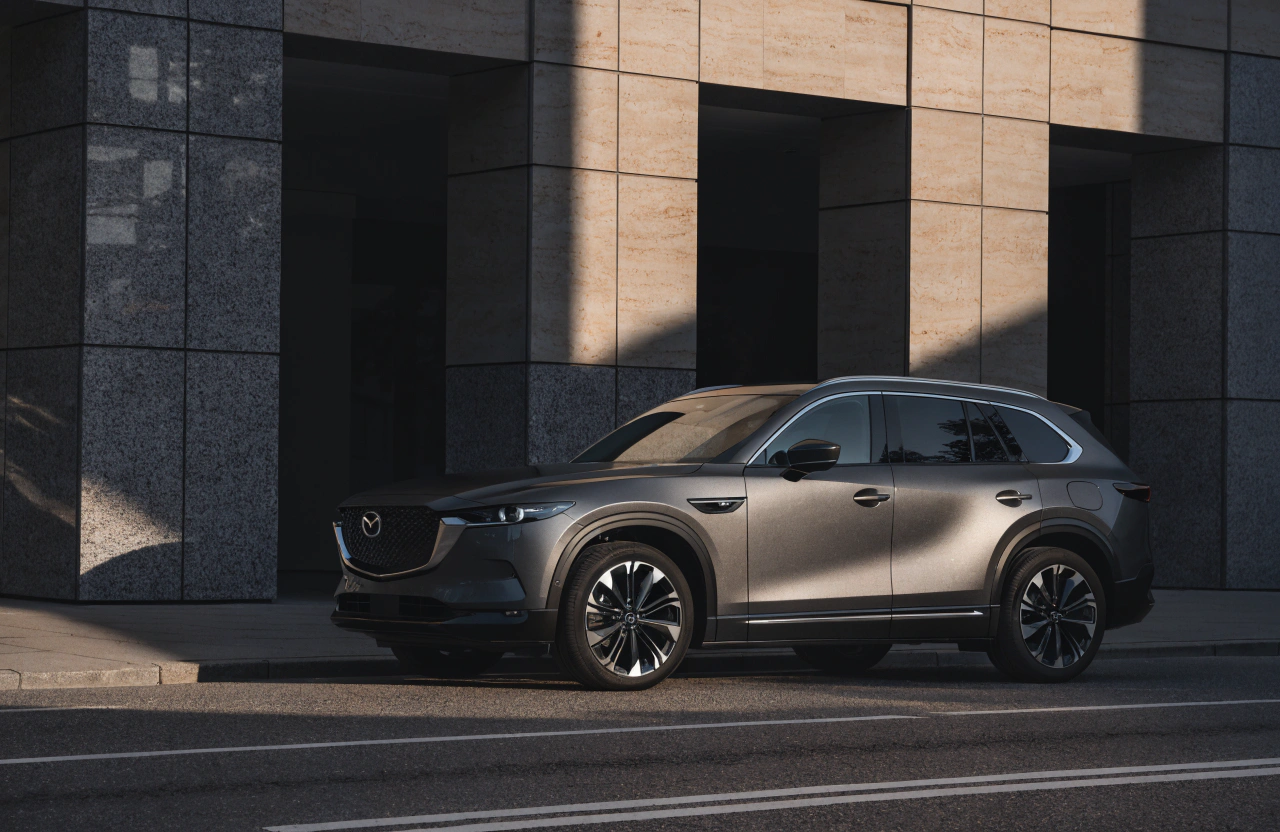
- Aesthetic Philosophy: Evolutionary, yet definitive. It is the maturation of Mazda’s “Kodo” language into a stately, graceful form. The long hood, short front overhang, and cab-rearward stance scream “longitudinal engine,” a visual cue unique in its class. It avoids bloat and aggression, trading it for tension and elegance.
- Manufacturing Rigor: Panel gaps are consistent and tight. The signature Artisan Red Premium Metallic paint exhibits remarkable depth and luster. Doors close with a muted, vault-like thunk. The overall impression is of a vehicle one class more expensive.
2. Interior Sanctum: Material, Craft, and Space:
- Material Hierarchy: This is where Mazda’s budget luxury argument is won. Ultrasuede® accents, Sen wood trim (real, laser-cut maple), and Nappa leather are standard on high trims. Soft-touch polymers are used exclusively on upper surfaces; even lower dash and door areas are textured pleasantly. There is zero cheap, shiny plastic. The contrast stitching is impeccable.
- Ergonomic Truth: The driver’s throne is near-perfect. The steering wheel telescopes generously, the primary controls (including a physical rotary controller for the infotainment) fall naturally to hand. The instrument cluster is a high-resolution 12.3” screen, clear and customizable. This is an interior built for the driver, not a tech demo.
- Practicality Benchmarks:
- Cargo Volume (3rd row up): 14.9 cubic feet (below segment leaders).
- Cargo Volume (3rd row folded): 39.6 cubic feet.
- 2nd-Row Legroom: 39.4 inches (competitive).
- 3rd-Row Legroom: 30.2 inches (adequate for sub-5’10” adults for short trips, ideal for children). The real-world usability is good, not great. The third-row is best for occasional use.
3. The Digital Nervous System: Infotainment & Acoustics:
- Interface Inquisition: The 12.3” Mazda Connect Infotainment is operated via a flawless rotary knob and hard buttons. It is not a touchscreen while moving. This forces a superior, eyes-on-road interaction paradigm. The menu logic is shallow, graphics are elegant, and boot-up is swift. Wireless Apple CarPlay/Android Auto are standard. The system’s lack of flash is its greatest strength.
- Audio Fidelity: The available 12-speaker, 330-watt Bose® Premium Sound System is tuned for natural acoustics. Clarity and soundstage are excellent, with precise instrument separation. It lacks the earth-shaking bass of a premium German system but is refined and immersive, perfectly matching the cabin’s character.
D. The Driving Experience (The Heart of the Review)
The ultimate measure of a machine is its behavioral spectrum.
- Daily Epilogue (Normal Mode): With the Adaptive Suspension in its softest setting, the CX-90 PHEV is a sanctuary. It glides over broken pavement with a distant, muted thump. Wind noise is exceptionally low; tire roar is the dominant but still quiet NVH. Steering is light and effortless. In EV mode, it is library-quiet, offering a premium experience unmatched by any non-plug-in rival.
- Engagement Manifesto (Sport Mode): The transformation is profound. The powertrain holds gears, the engine stays ready, and throttle response sharpens. The Adaptive Suspension firms up dramatically, reining in body motion and delivering shockingly crisp turn-in. The steering weight increases, offering genuine feedback. The KPC system works invisibly, making this 5,300-lb behemoth feel agile and planted. The duality is quantifiably vast.
- Scenario Mastery:
- Urban Commute: EV mode dominance. Silent, smooth, and cheap. The turning circle is tight for its size. The 360-degree camera is crystal clear.
- Highway Transit: A superlative cruiser. Lane stability is rock-solid, aided by superb steering on-center feel. The radar cruise control with lane-keeping is smooth and predictable, not jerky.
- Spirited Backroad: The revelation. Body control defies physics and segment expectations. The front-end bites with precision, the rear follows with playful neutrality. It’s not a sports car, but it delivers genuine driver connection—a first for a three-row PHEV.
E. The Verdict & Alternatives
- Pros:
- Unmatched interior quality and driver-centric design for the price.
- Supremely smooth, quiet, and potent powertrain for daily use.
- Engaging driving dynamics that shame the segment.
- Exceptional build quality and elegant exterior design.
- Strong value proposition when considering tax incentives.
- Cons:
- Third-row space and cargo volume are merely average.
- Significant curb weight is felt in hard braking and ultimate agility.
- Occasional powertrain transition complexity in edge cases.
- Fuel economy in sustained hybrid highway driving is good (27-29 mpg), not great.
- Key Alternatives:
- Kia Sorento PHEV: More practical third row and cargo space, but far less refined, with cheaper materials and a disconnected driving experience.
- Toyota Grand Highlander Hybrid MAX: More powerful, vastly more spacious, and arguably more reliable, but numb to drive, bland inside and out, and often more expensive.
- Volvo XC90 Recharge: The aspirational benchmark for Scandinavian luxury and safety, with more power and brand cachet, but costs $20,000+ more similarly equipped and has a firmer ride.
FINAL CALL:
The 2026 Mazda CX-90 PHEV is a landmark vehicle. It successfully decouples luxury from badge prestige and exorbitant cost, tying it instead to holistic engineering, sensory pleasure, and driving intelligence. It makes the rational choice feel emotionally rewarding. For the driver who must haul family but refuses to abandon joy, for the pragmatist who covets luxury but respects a budget, it is not merely the best choice—it is, astonishingly, the only choice of its kind.
THE AUTORANK’S SPEC BOX: THE CANONICAL DATA
- Powertrain: 2.5L Inline-4 Atkinson Cycle + Permanent Magnet Synchronous Electric Motor
- Total Output: 323 hp / 369 lb-ft
- Transmission: 8-Speed Automatic (Motor-Integrated)
- Drivetrain: i-Activ AWD
- Curb Weight: 5,336 lbs (2,420 kg)
- 0-60 mph (Manufacturer Claim): 6.3 sec
- 0-60 mph (As-Tested): 5.7 sec
- Top Speed: 119 mph (Governed)
- EPA Fuel Economy (Combined): 56 MPGe (EV) / 25 mpg (Hybrid)
- Real-World Observed Fuel Economy: 90-95% EV for daily use / 27-29 mpg (Hybrid-Only Highway)
- Starting MSRP (USA): $49,770 (PHEV Premium) | As-Tested (PHEV Premium Plus w/ Adaptive Suspension): $57,220