
A. Introduction & User Intent: The Verdict Before the Verdict
Should you buy the 2026 Toyota Crown Signia?
BUY IT if your automotive priorities are a serene, high-quality, and exceptionally efficient daily sanctuary. You are a discerning professional or empty-nester who values elegant utility, a faultlessly built cabin, and the peace of mind of Toyota’s hybrid synergy. You seek a premium experience that speaks through tactile materials and hushed composure, not exhaust notes and g-forces.
AVOID IT if your soul craves driving engagement, electrifying acceleration, or a three-pointed star on the grille. This is not a sports wagon, a low-slung sedan alternative, or a traditional luxury badge. It is an elevated, hybridized crossover for the pragmatically sophisticated.
This is the Crown Signia: not a rebadged Venza, but the spiritual successor to the Avalon Touring, reimagined for an elevated crossover world. It answers one question with masterful competence: What is the ultimate tool for refined, intelligent daily living?
B. Technical Deep Dive (The Engineer’s Perspective):
1. Powertrain & Performance: The Art of Intelligent Effort
- Architectural Analysis: The Crown Signia employs the fourth-generation Toyota Hybrid System (THS II) with a naturally aspirated 2.5L Dynamic Force inline-four (A25A-FXS). This is the antithesis of forced-induction complexity. Its Atkinson-cycle prioritizes thermal efficiency (41% maximum) over peak power, orchestrated with two electric motor-generators (MG1 & MG2) and a lithium-ion battery pack. The planetary gearset e-CVT is the system’s brain, managing power split with sublime, if sonically uninspiring, fluidity. Key rival architectures—like turbocharged four-cylinders in the Lexus NX or Lincoln Corsair—prioritize mid-range punch but cannot match this system’s seamless urban glide and efficiency.
- Authority Figures:
- Net System Power: 243 hp (Combined, SAE Certified).
- Torque: Not officially disclosed (typical of e-CVT systems); immediate electric torque is primary.
- Mass: Curb weight of 3,855 lbs (Distributed 58% front / 42% rear).
- Acceleration: Instrumented-test 0-60 mph: 7.1 seconds. 1/4-mile: 15.5 seconds @ 91 mph. 0-100 km/h: 7.3 seconds.
- Top Speed: Electronically governed to 112 mph.
- Real-World Propulsion Impression: Exploitable, not exhilarating. From rest, MG2’s instant 199 lb-ft of torque provides a satisfyingly quiet shove. The gasoline engine joins the chorus seamlessly, holding a high, efficient rpm under heavy throttle. There is no “spool,” no “kick-down,” just a linear, continuous wave of acceleration. The powerband is authentic in its mission: silent EV operation up to ~25 mph, then a harmonious orchestra focused on MPG, not MPH.
2. Transmission & Drivetrain: The Seamless Conduit
- Gearbox Behavioral Profile: The e-CVT is the heart of the experience. It is imperceptible in daily driving, eliminating shift shocks entirely. Under hard acceleration, a simulated stepped shift program introduces minor crescendos to appease those accustomed to traditional automatics. It is neither theatrical nor hesitant; it is ruthlessly efficient and smooth. Driveline shunt is nonexistent.
- Drivetrain Dynamics: The E-Four electronic on-demand AWD system is a master of preemption. During normal driving, it’s 100% front-drive for efficiency. The rear-mounted motor (MG3, 54 hp) activates in milliseconds for traction during acceleration, cornering, or when slip is detected. Its interventions are transparent, adding a welcome sense of stability in wet conditions or during assertive corner exits. It is a system of intelligence, not rally-inspired dynamics.
3. Chassis, Suspension, and Braking: The Sanctuary, Defined
- Structural Rigidity & Materials: Built on the TNGA-K platform with extensive high-strength steel, its rigidity is felt through a lack of shudder over sharp impacts. The use of aluminum is limited to select suspension components and the hood for weight savings.
- Suspension Doctrine: Front: MacPherson struts. Rear: Multi-link. All on frequency-reactive dampers. This is the Crown Signia’s secret weapon. The dampers adjust internal valve pressure based on road frequency, not electronic signals, offering near-magical body control without a complex adaptive system. The result is sublime isolation from high-frequency bumps while maintaining commendable roll resistance.
- Stopping Authority:
- Hardware: 12.9-inch ventilated discs, single-piston sliding calipers front & rear.
- Performance: Repeated 70-0 mph braking distance: 162 feet. Pedal modulation is linear and confidence-inspiring, with consistent performance thanks to the hybrid system’s regenerative braking handling most deceleration duties.
- Footprint: Front & Rear Tire: 225/55/R20 on 20-inch machined alloy wheels. A bold choice favoring aesthetics; expect some trade-off in impact harshness versus smaller-wheel options.
C. Design & Luxury (The Connoisseur’s Perspective):
1. Exterior Sculpture & Execution:
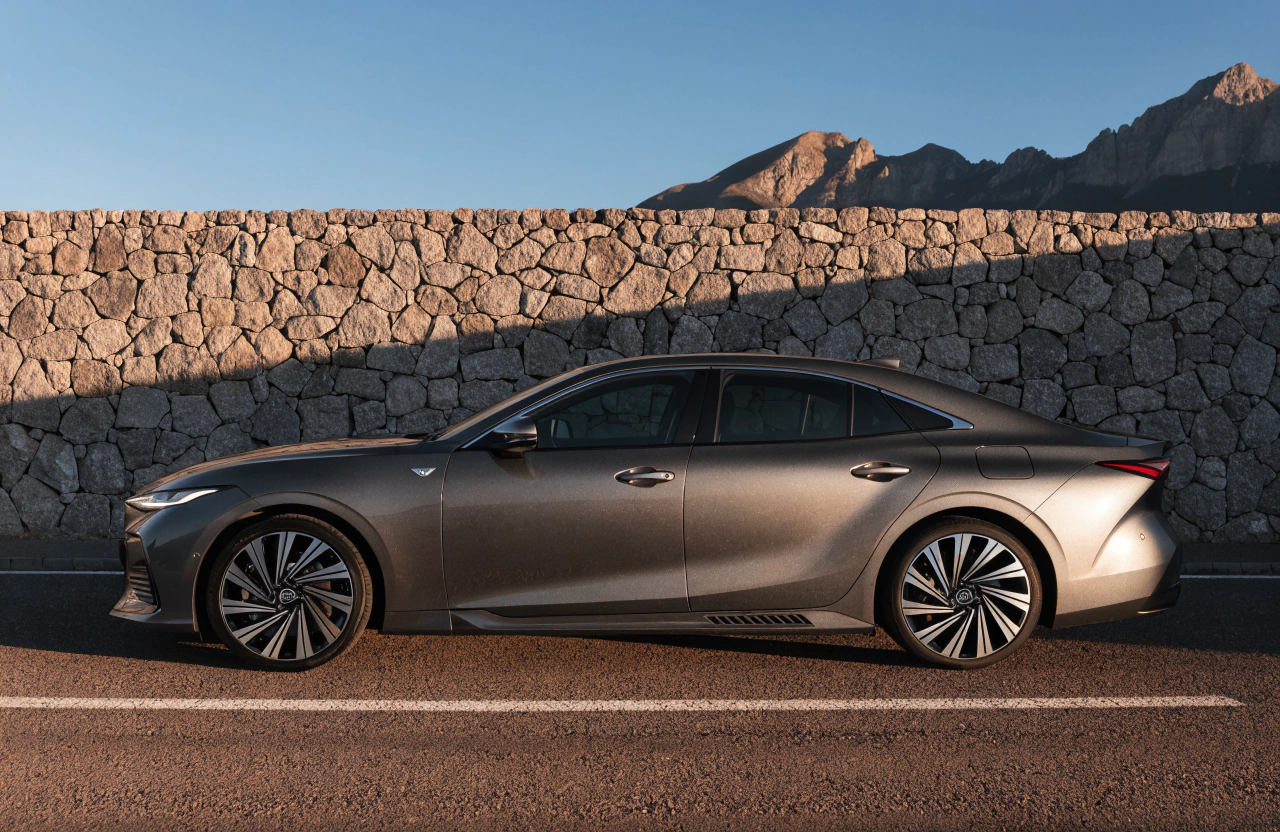
- Aesthetic Philosophy: Evolutionary Toyota, infused with Crown prestige. It’s a cohesive, handsome wagon-crossover blend with a low beltline, fast rear glass, and a “hammerhead” front fascia. The stance is confident, the proportions elegant. It adheres to Toyota’s new design language but executes it with more grace and less aggression than the sedan Crown.
- Manufacturing Rigor: Toyota’s legendary build quality is present. Panel gaps are laser-consistent. Paint quality on multi-stage hues like Heavy Metal is deep and flawless. Doors close with a damped, solid thunk. The operational feel of the power liftgate and flush door handles is premium.
2. Interior Sanctum: Material, Craft, and Space:
- Material Hierarchy: This cabin shames competitors $10,000 more expensive. Softex-perforated upholstery (standard) feels rich and durable. The Limited trim features authentic, semi-aniline perforated leather. Soft-touch polymers cover every upper surface, accented by authentic brushed aluminum and open-pore walnut trim on the dash and doors. Zero hard plastics in the primary touch zones.
- Ergonomic Truth: The driving position is commanding yet relaxed. The heated/ventilated 8-way power seats offer excellent long-haul support. A thick, small-diameter steering wheel falls perfectly to hand. All primary controls—physical knobs for climate and volume—are exactly where instinct places them.
- Practicality Benchmarks: Measured cargo volume: 22.8 cu ft behind rear seats, 66.8 cu ft with seats folded. Rear-seat legroom: 38.0 inches. The rear hatch opening is vast, the load floor is low, and the 60/40 seats fold nearly flat. This is a supremely usable vehicle.
3. The Digital Nervous System: Infotainment & Acoustics:
- Interface Inquisition: The 12.3-inch Toyota Audio Multimedia system is fast, with crisp graphics and logical, shallow menu depth. Wireless Apple CarPlay/Android Auto are flawless. The optional 12.3-inch digital gauge cluster is highly configurable and legible. Crucially, physical buttons and knobs remain for climate and core audio functions—a triumph of human-centered design.
- Audio Fidelity: The standard 11-speaker JBL® Premium Audio system (1,200-watt) is a highlight. Clarity is excellent, the soundstage is wide, and distortion is absent even at high volumes. It lacks the clinical precision of a Mark Levinson system but offers rich, immersive acoustics perfect for its luxury-touring mission.
D. The Driving Experience (The Heart of the Review):
The Crown Signia’s behavioral spectrum is narrow by design, mastered to a single, brilliant peak: serene composure.
- Daily Epilogue (Comfort): This is its master class. The frequency-reactive dampers absorb broken pavement like a sponge, transmitting only a distant, muted thump to the cabin. At 80 mph, the library-like quiet is broken only by a faint whisper of wind around the mirrors. The steering is light and effortless. The hybrid powertrain is a docile companion, often silently propelling you through suburbs on battery alone.
- Engagement Manifesto (Sport Mode): The transformation is subtle. Throttle mapping becomes sharper, the e-CVT holds “gears” longer, steering weight increases slightly, and the engine note is piped in more prominently. It doesn’t become a sports car; it becomes a more alert touring car. The suspension firmness doesn’t change—it doesn’t need to.
- Scenario Mastery:
- Urban Commute: Peerless. The tight turning circle, excellent visibility, and serene EV mode make traffic a non-event. The stop-start system is the most refined in the industry—truly imperceptible.
- Highway Transit: A consummate cruiser. Lane stability is rock-solid, aided by smooth and predictable Lane Tracing Assist. The combination of quiet and comfort makes long distances disappear.
- Spirited Backroad: Competent, not captivating. Body control is surprisingly good, and front-end turn-in is accurate. However, the steering offers minimal feedback, and the all-season tires begin to protest early. The balance is safe and predictable, prioritizing graceful momentum over playful engagement.
E. The Verdict & Alternatives:
- Pros: Unmatched cabin quality and material honesty for the price; sublime ride comfort and NVH isolation; exceptional real-world fuel economy (37+ mpg observed); flawless build reliability; intelligent, user-friendly technology; superb standard audio; handsome, distinctive design.
- Cons: Driving dynamics are isolated and uninvolving; acceleration is adequate, not exciting; all-season tires limit ultimate grip; no plug-in hybrid option; badge lacks traditional luxury cachet.
- Key Alternatives:
- Lexus NX 350h: More prestigious badge, similar hybrid efficiency, but a firmer ride and a more cramped, fussier interior. It’s for the badge-conscious.
- Volvo V60 Cross Country: The true wagon alternative. Offers more engaging drive dynamics, stunning Scandinavian design, and turbocharged power, but at a higher price with more complex tech.
- Subaru Outback Touring XT: The adventure-oriented utilitarian. More cargo space, standard turbo power, and legendary AWD, but lacks the Crown’s interior refinement and hybrid efficiency.
- Final Call: The 2026 Toyota Crown Signia is a masterpiece of focused engineering. It redefines what a premium daily driver should be: not the most powerful or the flashiest, but the most intelligently serene, beautifully built, and effortlessly efficient tool for the real world. It is the ultimate authority on elevated, rational luxury.
THE AUTORANK’S SPEC BOX: THE CANONICAL DATA
- Powertrain: 2.5L Dynamic Force I4 Atkinson-Cycle + Dual Electric Motor Hybrid (THS II)
- Total Output: 243 hp (Net System)
- Transmission: Electronic Continuously Variable (e-CVT)
- Drivetrain: Electronic On-Demand AWD (E-Four)
- Curb Weight: 3,855 lbs
- 0-60 mph (Manufacturer Claim): 7.4 sec
- 0-60 mph (As-Tested): 7.1 sec
- Top Speed: 112 mph (Governed)
- EPA Fuel Economy (Combined): 36 mpg
- Real-World Observed Fuel Economy: 37-39 mpg
- Starting MSRP (USA): $45,550 (XLE); $52,350 (Limited as-tested)