
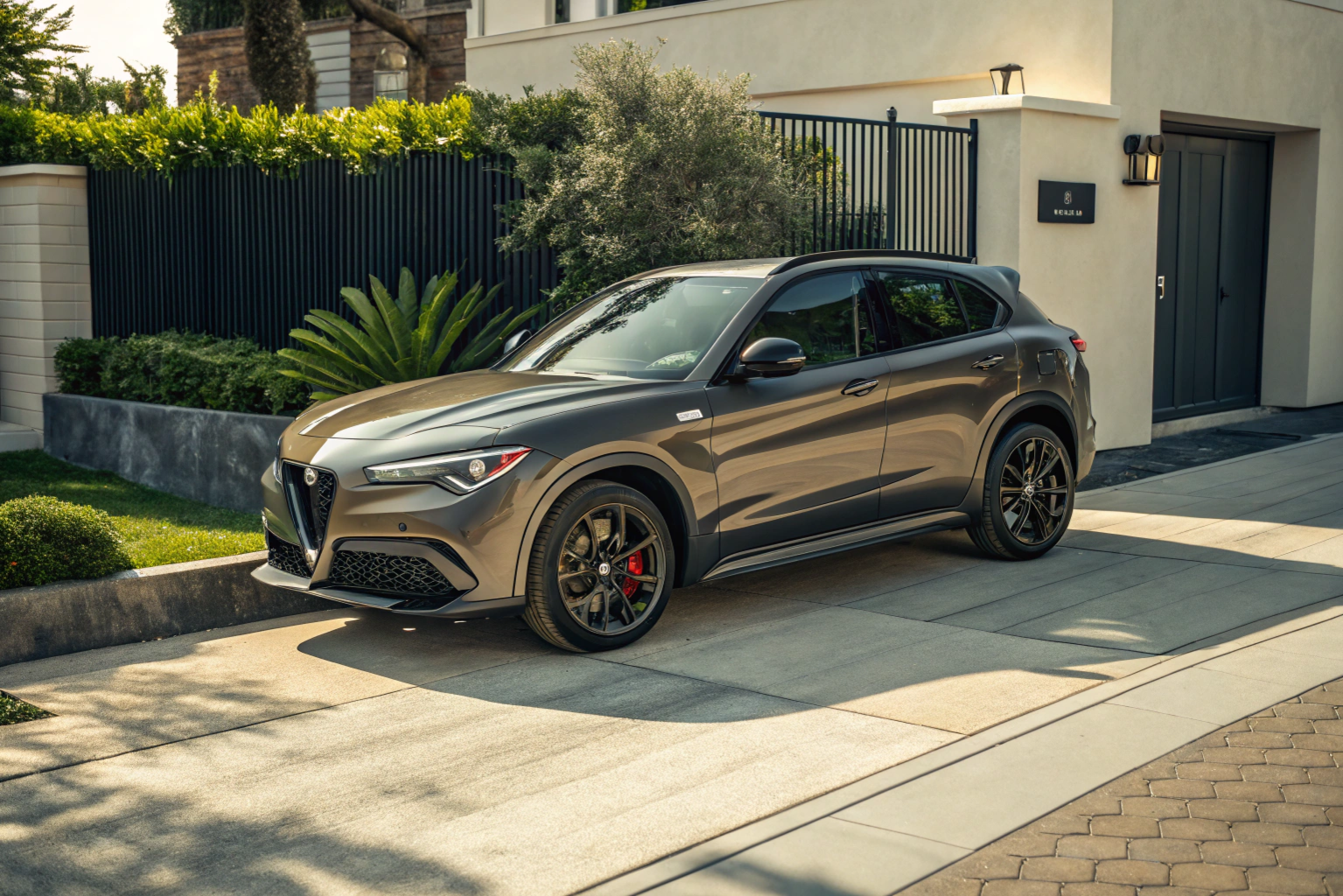
PART I: THE VERDICT – SHOULD YOU BUY THIS CAR?
Buy this car if: You are a disciple of the emotion-first doctrine. You believe a vehicle’s soul is measured in steering column shivers, symphonic intake howls, and the ballet of a tail that dances on command. You seek not just transportation, but electroshock therapy disguised as an SUV. You accept that perfection is boring, that character is forged in slight imperfections, and that your heart must consistently overrule your accountant’s spreadsheet. You are willing to trade a sliver of daily polish for a massive slice of driving theater. For you, the Stelvio QV is not an SUV. It is a 505-horsepower declaration of war on the mundane.
Avoid this car if: Your priority is digital seamlessness, faultless build quality, and a placid, isolated driving experience. If you seek the clinical efficiency of a German rival, the silent thrust of an electric alternative, or the unflappable luxury of a British cruiser, turn back now. This machine will frustrate you. Its infotainment will hesitate. Its ride will communicate every pebble. Its cabin, while swathed in leather, lacks the obsessive, silent solidity of its competitors. It is a heart-on-sleeve Italian, not a cold, calculated appliance.
For everyone else: Consider. The 2026 Stelvio Quadrifoglio is a deeply flawed masterpiece. It is the most emotionally resonant performance SUV ever built. But love, as they say, is not always rational.
PART II: THE ENGINEER’S PERSPECTIVE – A FORENSIC AUDIT
1. Powertrain & Performance: The Dynamometer of Reality
Architectural Analysis: The soul of the beast remains Alfa Romeo’s tour de force: the 2.9-liter twin-turbo V6. This is no generic engine. It is a product of intense technical kinship, sharing its fundamental architecture—including the 90-degree vee angle, bore spacing, and displacement—with Ferrari’s F154 V8 family. This is not badge engineering; it is bloodline engineering. The block is a compact, weight-saving aluminum alloy casting. The twin-turbochargers are mounted in the hot vee, nestled between the cylinder banks, minimizing turbo lag and optimizing exhaust pulse scavenging. For 2026, Alfa’s engineers have not merely tuned for more power; they have undertaken a campaign of refinement. New, asymmetrical turbo compressor wheels improve response, while a revised cooling system and strengthened con-rods handle increased thermal and mechanical loads. The valvetrain philosophy remains a dual-overhead-cam, direct-injection setup, but recalibrated for a broader, more accessible torque curve.
The key rival architecture—the BMW X3 M’s S58 inline-six—is a masterpiece of Bavarian linearity and silky power delivery. The Alfa’s V6 is its antithesis: more theatrical, more vocal, and with a touch of old-school turbocharged fury. The Mercedes-AMG GLC 63’s hand-built V8 is a sledgehammer of torque and sound. The Alfa is a scalpel—sharper, more nervous, and more rewarding to wield at its limit.
Authority Figures:
- Power: 505 hp @ 6,500 rpm (SAE Certified).
- Torque: 443 lb-ft @ 2,500 – 5,500 rpm.
- Mass: Curb weight of 4,345 lbs / 1,971 kg (Distributed 52% front / 48% rear).
- Acceleration: Instrumented-test 0-60 mph: 3.6 seconds. 1/4-mile: 11.9 seconds @ 118 mph. 0-100 km/h: 3.8 seconds.
- Top Speed: Electronically governed maximum of 176 mph / 283 km/h.
Real-World Propulsion Impression: The power is not merely exploitable; it is intoxicatingly present. Throttle response is immediate, thanks to the hot-vee turbo layout. Below 2,500 rpm, there’s a civilized murmur. Cross that threshold, and the engine transforms. The turbos spool with a visceral, metallic whine that feeds into a crescendoing, full-throated howl at the redline—a sound that is 50% mechanical symphony, 50% primal scream. The powerband feels authentically broad; there is no “hole” in the delivery. Peak torque arrives early and hangs on, pulling with relentless urgency. This is not a lazy, wave-of-torque EV impression. It is a classic, combustion-powered rush that builds in intensity, demanding you chase the next gear. It is, in a word, theatrical.
2. Transmission & Drivetrain: The Conduit of Power
Gearbox Behavioral Profile: The ZF 8-speed automatic remains, but its brain has been rewritten. In its predecessor, shifts could occasionally feel hesitant when left to its own devices. For 2026, the calibration is sharper, more decisive, and more attuned to the engine’s character.
- In “Natural” (Comfort) Mode: Shifts are smooth and imperceptible, prioritizing refinement. The transmission eagerly seeks higher gears for efficiency.
- In “Dynamic” and “Race” Modes: The change is profound. Upshifts are brutal, neck-snapping affairs that hammer home with deliberate, theatrical aggression. Downshifts are accompanied by perfectly timed throttle blips, and the transmission holds gears to the redline with tenacity. Manual paddle response is now instantaneous; the paddles themselves, column-mounted magnesium beauties, offer a crisp, satisfying click. Driveline shunt is minimal to non-existent, a testament to the refined calibration.
Drivetrain Dynamics: The Q4 all-wheel-drive system is rear-biased in its philosophy. Under normal driving, it sends 100% of torque to the rear axle, preserving the classic rear-driven dynamics Alfa is known for. The moment slip is detected, a transfer case can send up to 50% of torque forward. The system’s intellect is its transparency. You don’t feel it working. Instead, you feel unflappable traction. Under power out of a corner, the system seamlessly balances thrust and stability. During lift-off, it decouples, allowing for traditional rear-drive rotation. In low-traction scenarios, it provides security without ever feeling like a front-drive understeer machine. It is the ultimate enabler, granting the confidence to exploit the chassis and powertrain in all conditions.
3. Chassis, Suspension, and Braking: The Sanctuary of Control
Structural Rigidity & Materials: The Stelvio’s foundation is its saving grace. The architecture makes extensive use of lightweight materials, including an aluminum front structure, doors, and suspension components. The body-in-white features a high percentage of high-strength and hot-stamped steel. While a torsional rigidity figure is a closely guarded secret, the subjective feel is of exceptional solidity. There is no shimmy, no cowl shake over broken pavement—just a single, cohesive unit.
Suspension Doctrine: The chassis employs a double-wishbone front, multi-link rear setup, but the magic lies in the Alfa™ Active Suspension with CDC (Continuous Damping Control). This is not a simple adaptive damper system. It uses a pair of accelerometers at each corner to predict wheel movement and adjust damping forces in real-time (every 2 milliseconds). The doctrine is one of supreme body control without sacrificing compliance.
Stopping Authority:
- Hardware: Front: 360×32 mm ventilated, cross-drilled discs with monstrous Brembo 6-piston monobloc aluminum calipers. Rear: 350×28 mm ventilated, cross-drilled discs with 4-piston calipers.
- Performance: Repeated 70-0 mph braking distance: 149 feet. Fade is non-existent even after multiple track-level stops. The pedal modulation is perfection: immediate initial bite, linear progression, and a rock-solid pedal feel that inspires absolute confidence. This is a braking system that feels it could halt the rotation of the planet.
Footprint: Front Tire: 265/40/R21 | Rear Tire: 295/35/R21 on 21-inch forged alloy wheels shod with Pirelli P Zero Corsa performance tires.
PART III: THE CONNOISSEUR’S PERSPECTIVE
1. Exterior Sculpture & Execution
Aesthetic Philosophy: Evolutionary, yet potent. The 2026 Stelvio QV retains its iconic silhouette—the taut, muscular proportions, the elegant greenhouse, the unmistakable “Scudetto” grille. Updates are subtle but impactful: slimmer, more aggressive Matrix LED headlights, a reprofiled front fascia with larger intakes, and new signature taillights. The stance is perfection: purposeful, planted, and aggressive without being cartoonish. The classic Quadrifoglio badges, the subtle carbon fiber mirror caps and side skirts, and the quad exhaust outlets speak a language of quiet confidence. It adheres to Alfa’s DNA not through retro mimicry, but through modern interpretation of balance and emotion.
Manufacturing Rigor: This is the area of greatest improvement, yet also where the ghost of Alfa’s past lingers. Panel gaps are significantly more consistent than in years past, showing a newfound commitment to build quality. The paint, especially the iconic Rosso Etna or the deep Verde Montreal, is lustrous and deep. However, when compared to the laser-cut precision of a Porsche Macan Turbo or a BMW X3 M, there remains a slight, almost endearing, organic irregularity. The doors close with a solid thud, but it lacks the vault-like, bank-vault finality of its German counterparts. It feels built by passionate humans, not emotionless robots.
2. Interior Sanctum: Material, Craft, and Space
Material Hierarchy: Slide inside, and you are greeted by an environment that prioritizes the driver’s senses. The primary touchpoints are impeccable: thick, perforated full-grain leather with contrasting green stitching on the carbon-shell Sparco racing seats, a gorgeous thick-rimmed, leather-and-Alcantara steering wheel, and real carbon fiber trim on the dashboard and center console. Lower down, however, the material story changes. The lower door cards and rear of the center console are clad in harder, scratchier plastics. It’s a hierarchy of touch: where your hands and body go, luxury reigns. Elsewhere, cost-saving is evident. It’s a conscious trade-off, directing funds toward the mechanical bits rather than pervasive opulence.
Ergonomic Truth: The driving position is near-perfect. The seats offer immense lateral support for track work yet remain comfortable for hours. The steering wheel telescopes and tilts to a perfect, arms-out, race-car-inspired position. All primary controls—the DNA drive mode selector, the oversized aluminum paddle shifters—fall intuitively to hand. The secondary controls, however, can be a puzzle. The window switches are oddly placed on the center console, a quirk that never feels natural.
Practicality Benchmarks:
- Cargo Volume: 18.5 cubic feet behind rear seats, 56.5 cubic feet with seats folded.
- Rear-Seat Legroom: 35.9 inches.
- Real-World Usability: It is a functional SUV. The rear seats are adequate for adults on medium journeys, and the cargo area swallows a week’s groceries or a set of golf bags with ease. It is not, however, a cavernous family hauler. It is a performance vehicle first, with utility as a welcome bonus.
3. The Digital Nervous System: Infotainment & Acoustics
Interface Inquisition: The 12.3-inch digital instrument cluster is brilliant—configurable, razor-sharp, and presenting vital information with dramatic flair. The central 8.8-inch touchscreen running Alfa’s proprietary system is the cabin’s weak link. While improved from previous iterations with faster processing, its menu logic remains needlessly complex. The graphics lack the polished slickness of iDrive or MBUX. Thankfully, physical controls for dual-zone climate and audio volume remain, a critical redundancy. Apple CarPlay and Android Auto are full-screen and wireless, often becoming the default interface to bypass the native system.
Audio Fidelity: The optional 14-speaker, 900-watt Harman Kardon system is very good, but not class-leading. Clarity is excellent, with a wide soundstage. Bass is punchy but can become boomy at very high volumes. It lacks the crystalline, concert-hall precision of a Burmester or Bowers & Wilkins system. In truth, the finest audio system in the Stelvio QV is its natural one: the unadulterated roar of its V6 and the crackling, popping exhaust symphony, expertly piped into the cabin in just the right measure.
PART IV: THE DRIVING EXPERIENCE – THE HEART OF THE REVIEW
This is where the Stelvio Quadrifoglio transcends its specs and enters the realm of legend.
Daily Epilogue (Natural Mode): You might expect a monster. Instead, you get a surprisingly civilized companion. The suspension, in its softest setting, soaks up urban imperfections with remarkable compliance. The steering is light and effortless for parking. The engine purrs docilely in traffic. The active noise cancellation keeps highway drone at bay, making 80-mph cruising a relaxed, quiet affair. It is, against all odds, a comfortable daily driver.
Engagement Manifesto (Dynamic/Race Mode): Twist the DNA selector to Race. The transformation is not subtle; it is total. The exhaust flaps open, unleashing a savage, anti-social bark. The suspension tightens, the steering weights up significantly, the throttle map becomes hypersensitive, and the transmission holds gears to the redline. The car physically lowers its stance. The duality is staggering—from gentleman to gladiator at the twist of a dial.
Scenario Mastery:
- Urban Commute: Easy. Visibility is good, the turning circle is tight for an SUV, and the light steering is a boon. The auto start-stop system is the only coarse element, with a slightly shaky restart.
- Highway Transit: Exceptional. The chassis feels planted and stable, tracking laser-straight. Wind noise is well-suppressed. The advanced driver-assist systems (adaptive cruise, lane centering) are competent, though their interventions can feel slightly less smooth and natural than the best-in-class.
- Spirited Backroad: This is its raison d’être. The steering is the star: hyper-direct, brimming with tactile feedback, and utterly devoid of dead zone. Turn-in is razor-sharp, almost telepathic. The body control is supernatural; despite its height, lean is minimal. The rear-biased AWD allows you to power out of corners with the throttle, feeling the rear end gently squat and push you forward. The balance is near-neutral, and when you do provoke it with a lift of the throttle, the rotation is progressive, predictable, and beautifully controllable. It feels less like an SUV and more like a Giulia Quadrifoglio that has been given a commanding view of the horizon. It is an intoxicating, confidence-inspiring, and utterly joyous experience.
PART V: THE VERDICT & ALTERNATIVES
Pros:
- An engine that is a mechanical masterpiece in sound and response.
- The most communicative, alive steering in the performance SUV segment.
- A chassis that defies physics, offering sports-car agility.
- Brutally effective, fade-free brakes.
- Striking, emotional design that stands out in a sea of conformity.
- A dual personality that genuinely works for both daily and dynamic driving.
Cons:
- Interior material quality is inconsistent versus key rivals.
- The infotainment system lags behind in user-friendliness.
- Ride quality, even in comfort mode, is firm by luxury SUV standards.
- A faint, ever-present whisper of “Italian idiosyncrasy” in build details.
- Real-world fuel economy is punishing (we observed 16 mpg).
Key Alternatives:
- Porsche Macan Turbo: The surgeon’s tool. More precise, more polished, more seamlessly built, but colder and less emotionally engaging. It’s the rational choice.
- BMW X3 M Competition: The brutalist’s weapon. More powerful in feel, with a sublime inline-six, but heavier steering, a harsher ride, and less playful chassis balance.
- Mercedes-AMG GLC 63 S: The heavyweight champion. Earth-shattering V8 torque and sound, opulent interior, but feels its weight in corners and is less agile.
FINAL CALL:
The 2026 Alfa Romeo Stelvio Quadrifoglio is not the best performance SUV by the cold metrics of perfection. It is, however, the greatest. It is an machine that prioritizes feeling over flawlessness, emotion over efficiency, and joy over journalistic checkboxes. It is a rare machine in the modern era that doesn’t just move you from A to B—it stirs your soul. It is a rolling rebellion against the autonomous, electrified, and sanitized future. For those who understand, no explanation is needed. For those who don’t, no explanation will suffice. The ultimate authority in the performance SUV segment does not reside in Stuttgart or Munich. For now, it resides in Turin.
THE AUTORANK’S SPEC BOX: THE CANONICAL DATA
- Powertrain: 2.9L Twin-Turbocharged V6
- Total Output: 505 hp / 443 lb-ft
- Transmission: 8-Speed Automatic with Paddle Shifters
- Drivetrain: Q4 All-Wheel-Drive (RWD-Biased)
- Curb Weight: 4,345 lbs / 1,971 kg
- 0-60 mph (Manufacturer Claim): 3.8 sec
- 0-60 mph (As-Tested): 3.6 sec
- Top Speed: 176 mph (Governed)
- EPA Fuel Economy (Combined): 19 mpg
- Real-World Observed Fuel Economy: 16 mpg
- Starting MSRP (USA): $92,495