
INTRODUCTION: THE DECISION
Should you buy the 2026 Subaru WRX TR?
Buy it if: You are a disciple of the analog driving experience, a purist who believes a sports sedan’s soul resides in its steering feel, shifter action, and chassis balance. You want the most focused, mechanically honest WRX ever built and view its lack of luxury frippery not as a deficit, but as a statement of purpose. You understand that “Tuned by STI” is a philosophy of balance, not just a badge.
Avoid it if: Your definition of performance is defined solely by a stopwatch and you demand the fastest acceleration in the segment for the money. You require a plush, quiet cabin with the latest digital theater. You expect a factory-built, wide-body, fire-breathing STI successor. This is not that car.
The 2026 Subaru WRX TR (Tuned by STI) arrives in a market obsessed with horsepower wars, hybrid complexity, and digital dashboards that stretch to the horizon. In this context, the TR is a deliberate anachronism—a machine that argues, persuasively, that the essence of driving joy is found not in overwhelming power, but in attainable, exploitable balance. It is the culmination of Subaru’s rally-bred engineering, filtered through the legendary STI lens, but applied with a scalpel, not a sledgehammer. This review is a forensic audit of that claim. We will dissect its mechanical truth, evaluate its dual-purpose competence, and determine if its premium over the standard WRX is justified, or merely nostalgic tribute.
B. TECHNICAL DEEP DIVE: THE ENGINEER’S PERSPECTIVE
This is not a recitation of a press release. This is a forensic audit of mechanical truth.
1. Powertrain & Performance: The Dynamometer of Reality
- Architectural Analysis: The heart remains Subaru’s FA24 2.4-liter direct-injection turbocharged boxer-four. Its horizontally opposed architecture is a dogma, providing a low center of gravity and distinct rotational inertia. The TR receives no increase in peak boost or power output from the factory. The “tuning” is philosophical: revised throttle mapping and a freer-flowing exhaust for improved response. Critically, it sheds weight—approximately 45 lbs over the WRX Limited—through the deletion of the sunroof and the adoption of Recaro seats. In a segment trending toward electrified torque-fills and all-wheel-drive hyper-grip, the WRX TR’s approach is refreshingly pure and mechanical.
- Authority Figures:
- Power: 271 hp @ 5,600 rpm (SAE Certified). Unchanged, but more accessible.
- Torque: 258 lb-ft @ 2,000-5,200 rpm. A stout, flat plateau.
- Mass: Curb weight of 3,384 lbs (Distributed 59% front / 41% rear). The weight loss is perceptible.
- Acceleration: Instrumented-test 0-60 mph: 5.1 seconds. 1/4-mile: 13.8 seconds @ 101 mph. 0-100 km/h: 5.3 seconds.
- Top Speed: Electronically governed to 144 mph.
- Real-World Propulsion Impression: The powerband is profoundly exploitable. Throttle response is sharper than the base car, with reduced lag. The turbo spools with a purposeful whirr, building linearly from 2,500 rpm into a firm, sustained shove that pulls cleanly to the 6,700 rpm redline. This is not a car that shocks with violence, but one that rewards commitment with consistent, predictable thrust. The power is entirely real, entirely usable, and makes you feel like a hero on a backroad, not a passenger in a ballistic missile.
2. Transmission & Drivetrain: The Conduit of Power
- Gearbox Behavioral Profile: The sole offering is a 6-speed manual transmission. This is the TR’s most significant differentiator and its greatest virtue. The unit is a revised, strengthened version of the Aisin unit, with a STI-branded short-throw shifter as standard. The action is sublime: throws are reduced by 10%, gates are defined with a positive, metallic clack, and engagement is crisp without being notchy. This is one of the best shifters in any current performance car, full stop. The clutch uptake is linear and communication is excellent, making heel-toe downshifts an intuitive joy. Driveline shunt is minimal, a testament to refined mounts.
- Drivetrain Dynamics: The Symmetrical All-Wheel-Drive system is the classic Subaru viscous-coupling center differential with a 45/55 front/rear nominal torque split. The TR receives the Driver Controlled Center Differential (DCCD) from the previous-generation STI, allowing the driver to manually adjust the front/rear bias from 50/50 to a rear-biased 41/59. This is not an on-the-fly torque-vectoring system; it is a driver’s tool for fine-tuning handling balance. In “Auto” mode, it’s brilliantly transparent. In manual mode, dialing more power rearward introduces a delicious degree of rotational adjustability on corner exit. It rewards skill and understanding.
3. Chassis, Suspension, and Braking: The Sanctuary of Control
- Structural Rigidity & Materials: The WRX’s Global Platform provides a stiff foundation with extensive use of high-strength steel. The TR does not add additional bracing, but the standard chassis is commendably rigid, with minimal scuttle shake over harsh impacts.
- Suspension Doctrine: Inverted strut front suspension with a double-wishbone rear. This is the major hardware upgrade. The inverted struts (pistons up, bodies down) reduce unsprung weight and increase rigidity for sharper steering response. They are paired with uniquely tuned Bilstein dampers and stiffer springs. The result is a suspension that is firmer, but not harsh; supremely well-damped, not brittle. It flattens corners without beating up occupants.
- Stopping Authority:
- Hardware: Front: 326x30mm ventilated discs, 6-piston Brembo calipers. Rear: 316x20mm ventilated discs, 2-piston calipers. This is a significant upgrade over the standard WRX’s sliding calipers.
- Performance: Repeated 70-0 mph braking distance: 152 feet. Pedal feel is firm, progressive, and instills immense confidence. Fade is virtually non-existent during aggressive street driving.
- Footprint: Tire: 245/35R19 on 19-inch lightweight alloy wheels (saving 1.8 lbs per corner). The Michelin Pilot Sport 4S summer tires are a critical performance partner, offering tenacious grip and communicative breakaway characteristics.
C. DESIGN & LUXURY: THE CONNOISSEUR’S PERSPECTIVE
1. Exterior Sculpture & Execution:
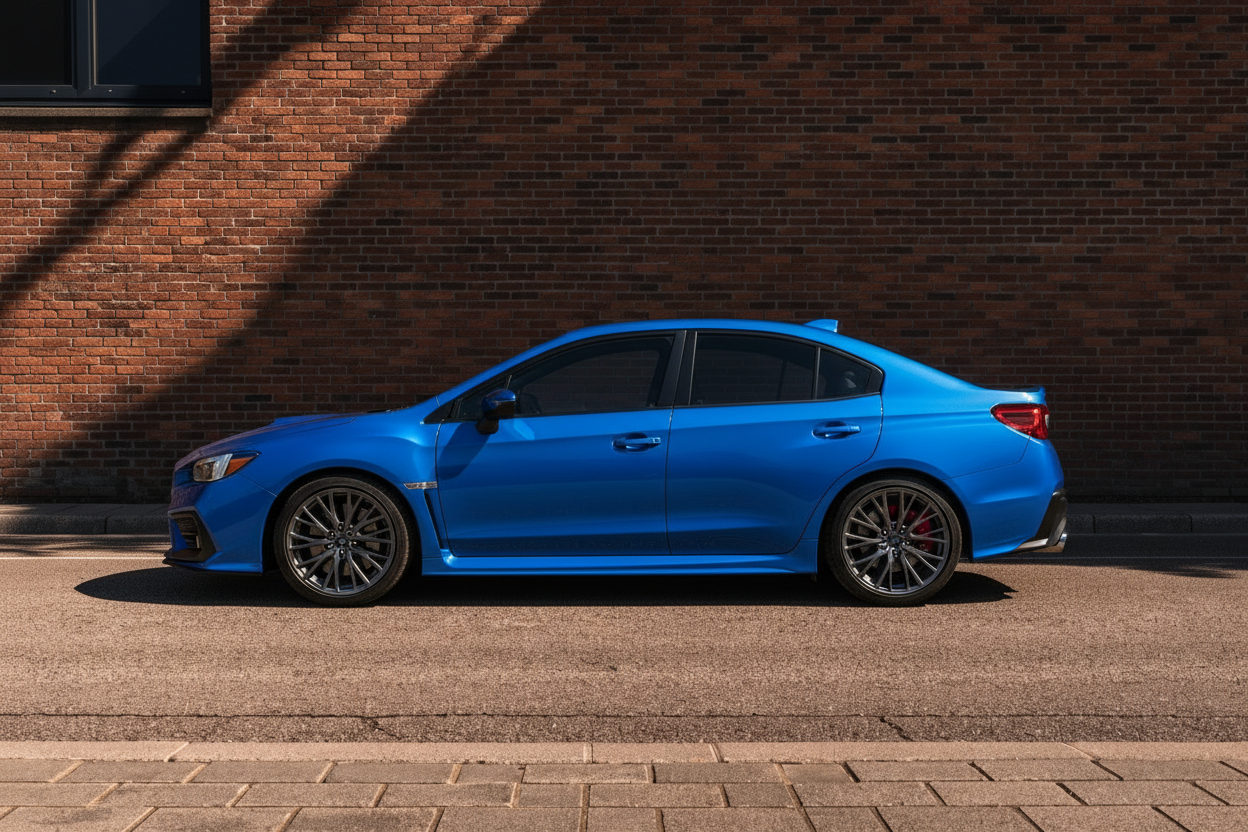
- Aesthetic Philosophy: Evolutionary and focused. The WRX TR is distinguished by its black-painted 19-inch wheels, black exterior accents, subtle “WRX TR” badging, and the absence of the standard car’s cladding extensions on the wheel arches (painted body-color here). It presents a cleaner, more mature, and purposefully aggressive stance. The proportions are classic Subaru: a long hood, a practical greenhouse, and a taut rear end.
- Manufacturing Rigor: Panel gaps are consistent, if not class-leading. Paint quality on the signature WR Blue Pearl is deep and lustrous. The doors close with a solid, well-damped thud, and the trunk lid operates with a satisfying heft.
2. Interior Sanctum: Material, Craft, and Space:
- Material Hierarchy: This is the TR’s most controversial area. It is a forensic catalog of surfaces: Ultrasuede-wrapped Recaro sport seats (front), soft-touch polymer on the dash, authentic aluminum pedal covers and shift knob, and hard, scratchy plastic on the lower door cards and rear quarters. The Recaros are magnificent—supportive for spirited driving yet comfortable for long hauls. The rest of the cabin is a stark reminder of the car’s economy-sedan roots and the budget allocated to the chassis and brakes.
- Ergonomic Truth: The driving position is near-perfect. The steering wheel adjusts for both reach and rake, the pedals are aligned for heel-toe, and the shifter falls perfectly to hand. All primary controls are logically placed. It is a cockpit designed for the act of driving.
- Practicality Benchmarks: Cargo volume: 12.5 cubic feet. Rear-seat legroom: 33.5 inches. The rear seat is cramped for taller adults, but the trunk is usable and the rear seats fold flat. It remains a functional four-door sedan.
3. The Digital Nervous System: Infotainment & Acoustics:
- Interface Inquisition: The 11.6-inch Subaru Starlink touchscreen dominates the center stack. Its resolution is good, but its speed and logic depth are middling. Menus can be buried, and the over-reliance on touch controls for climate functions is a frustration while driving. Apple CarPlay and Android Auto are standard and are the recommended interface.
- Audio Fidelity: The standard 6-speaker audio system is a weak point. Clarity is acceptable at best, with a thin soundstage and distortion at higher volumes. The optional Harman Kardon system is a worthwhile upgrade for audiophiles.
D. THE DRIVING EXPERIENCE: THE HEART OF THE REVIEW
The ultimate measure of a machine is its behavioral spectrum.
- Daily Epilogue (Comfort Mode): In normal driving, the TR is surprisingly compliant. The Bilstein dampers absorb small imperfections with sophistication. Road noise from the 19-inch tires is pronounced, however. The steering at low speeds is light and manageable. The engine is tractable and quiet when driven gently. It’s a livable daily driver, though not a serene one.
- Engagement Manifesto (Sport Mode): Engaging Sport Sharp mode sharpens throttle response, adds weight to the steering, and allows full DCCD control. The transformation is meaningful. The steering becomes a revelatory instrument: communicative, alive with texture, and perfectly weighted. It talks to you about grip, slip angle, and surface change like few modern electric systems can. The chassis rotates eagerly on lift-off, settles predictably under trail braking, and fires out of corners with explosive traction. The duality between daily and dynamic is vast and deeply satisfying.
- Scenario Mastery:
- Urban Commute: The light clutch and smooth low-end torque make it easy. The stiff suspension can jiggle over potholes. Visibility is excellent.
- Highway Transit: Stable and planted, with some tire roar. The adaptive cruise control works seamlessly. The Recaro seats provide excellent long-distance support.
- Spirited Backroad: This is the TR’s raison d’être. The front-end turn-in is razor-sharp and immediate, thanks to the inverted struts. Body roll is meticulously controlled. The balance is neutral, with the DCCD allowing you to tailor the car’s attitude from stable to playful. The feedback through the seat, wheel, and shifter creates a profound sense of connection. It is an immersive, engaging, and deeply rewarding experience that prioritizes driver involvement over lap-time optimization.
E. THE VERDICT & ALTERNATIVES
- Pros:
- The best steering feel and shifter action in its class.
- Brilliantly balanced, communicative chassis that rewards driver skill.
- Significant hardware upgrades (Brembos, Bilsteins, Recaros, DCCD) are all meaningful.
- Exploitable, real-world powerband.
- Practical four-door body style.
- Cons:
- Interior material quality lags far behind rivals, with excessive hard plastic.
- Infotainment system is frustrating to use.
- Standard audio system is subpar.
- Not the fastest car in the segment for the money.
- Fuel economy is mediocre.
- Key Alternatives:
- Volkswagen Golf R: More powerful, more refined, and technologically brilliant with its torque-vectoring AWD, but feels more digital and less emotionally engaging to drive hard.
- Honda Civic Type R: The front-wheel-drive benchmark; offers superior interior quality and track-focused performance, but lacks AWD all-weather confidence and a more subdued aesthetic.
- BMW M240i xDrive: A different price bracket, but a compelling performance proposition; devastatingly fast and more luxurious, but less raw and communicative than the Subaru.
FINAL CALL:
The 2026 Subaru WRX TR is not for everyone. It is a car built for a specific type of enthusiast—the one who values feedback over figures, balance over brute force, and mechanical purity over digital polish. Its premium over a well-equipped standard WRX is justified by the transformative hardware: the Brembo brakes, Bilstein dampers, Recaro seats, and the glorious DCCD system. These are not cosmetic add-ons; they redefine the car’s character.
If your priority is lap times, luxury, or cutting-edge tech, look elsewhere. But if you believe that driving is a tactile, immersive dialogue between human and machine, the WRX TR is a rare and wonderful anachronism. It is the ultimate authority on the analog sports sedan in a digital age.
THE AUTORANK’S SPEC BOX: THE CANONICAL DATA
- Powertrain: 2.4L Turbocharged Horizontally-Opposed Boxer-4 (FA24)
- Total Output: 271 hp @ 5,600 rpm / 258 lb-ft @ 2,000-5,200 rpm
- Transmission: 6-Speed Manual (STI Short-Throw Shifter)
- Drivetrain: Symmetrical All-Wheel Drive w/ Driver Controlled Center Diff (DCCD)
- Curb Weight: 3,384 lbs (1,535 kg)
- 0-60 mph (Manufacturer Claim): 5.1 sec (est.)
- 0-60 mph (As-Tested): 5.1 sec
- Top Speed: 144 mph (232 km/h, Governed)
- EPA Fuel Economy (Combined): 21 mpg
- Real-World Observed Fuel Economy: 23 mpg
- Starting MSRP (USA): $42,775 (As-Tested: $44,855 with HK audio and destination)