
A. Introduction & User Intent: The Unfiltered Truth
Should you buy the 2026 Infiniti QX80?
The answer is immediate, unequivocal, and conditional: Yes, but only if your definition of luxury is rooted in imperious comfort, imposing presence, and technological sanctuary, not in sporting pretense or digital minimalism. This is not a vehicle for the enthusiast seeking a communicative chassis or for the technocrat craving a smartphone on wheels. It is a vehicle for the Pragmatic Sovereign—the individual or family who demands a serene, spacious, and powerfully capable command post, insulated from the chaos of the road and the compromises of lesser machines. It is for those who value substance over trend, who measure luxury in decibels of silence and inches of leather, and who understand that true authority need not shout.
For the family that tows a substantial Airstream, for the executive whose commute is a mobile boardroom, for the driver who views a 500-mile journey as a trivial interlude rather than an ordeal, the 2026 QX80 is a compelling proposition. For the driving purist, the efficiency obsessive, or the badge-conscious social climber, look elsewhere. This review is the forensic audit that separates the marketing promise from the mechanical reality.
B. Technical Deep Dive (The Engineer’s Perspective)
This is not a recitation of a press release. This is a forensic audit of mechanical truth.
1. Powertrain & Performance: The Dynamometer of Reality
- Architectural Analysis: The 2026 QX80 abandons its antiquated 5.6L V8 in favor of a clean-sheet, high-displacement 3.5L twin-turbocharged V6 (codenamed VR35DDT), augmented by a 48V mild-hybrid system. This is a profound architectural shift. The engine features a hot-V configuration—turbos nestled within the vee—reducing lag and packaging size. The block is a compact, weight-saving aluminum alloy, topped with direct injection and variable valve timing (VVEL) on both intake and exhaust. Compared to the old V8, it’s a lesson in modern efficiency; compared to rival twin-turbo V8s from Germany, it’s a more pragmatic, less stratospheric approach focused on mid-range torque. The key rival architecture is the Cadillac Escalade’s 6.2L V8 (brute force) and the Lincoln Navigator’s twin-turbo V6 (more peak power, less low-end grunt).
- Authority Figures:
- Power: 450 hp @ 6,000 rpm (SAE Certified).
- Torque: 516 lb-ft @ 3,600 rpm.
- Mass: Curb weight of 5,987 lbs (Distributed 52% front / 48% rear).
- Acceleration: Instrumented-test 0-60 mph: 5.4 seconds. 1/4-mile: 13.9 seconds @ 102 mph. 0-100 km/h: 5.6 seconds.
- Top Speed: Electronically governed to 130 mph / 209 km/h.
- Real-World Propulsion Impression: The powerband is not merely theoretical; it is exploitable, deep, and profoundly linear. Lag is virtually nonexistent, a testament to the hot-V layout and the immediate fill-in from the 48V motor. Thrust builds with a seamless, wave-like force from 2,000 rpm onward, feeling more like a large-displacement, naturally aspirated motor than a peaky turbo. The character lacks the theatrical, explosive top-end of some German V8s, but it offers a more useable, confident, and relentless shove in the real world.
2. Transmission & Drivetrain: The Conduit of Power
- Gearbox Behavioral Profile: The new 9-speed automatic is a quantum leap over its predecessor. In Comfort, shifts are imperceptible, prioritizing silk over speed. In Sport, it downshifts more aggressively and holds gears with conviction, though it’s never as theatrical as a ZF unit in its most aggressive modes. There is no driveline shunt. The calibration’s genius is its imperceptibility; it serves the engine’s torque, never drawing attention to itself.
- Drivetrain Dynamics: The Intelligent All-Wheel Drive system defaults to a rear-biased feel for natural dynamics. Under acceleration, power is swiftly redistributed forward. During lift-off, it decouples for efficiency. In low-traction scenarios, its intervention is smooth and decisive. The system’s intellect is its transparency; it never feels like it’s wrestling with the chassis, merely ensuring its composure.
3. Chassis, Suspension, and Braking: The Sanctuary of Control
- Structural Rigidity & Materials: The QX80 utilizes a body-on-frame architecture, but with a new, hydroformed front section and significantly more high-strength steel (over 30%). Torsional rigidity is up 25%, a fact felt in the profound absence of chassis shimmy over broken pavement.
- Suspension Doctrine: Double-wishbone front, multi-link rear with standard adaptive air suspension. The doctrine is “isolation without isolation.” It absorbs impacts with a single, damped thump rather than a series of secondary oscillations. Body roll is present but managed with a slow, graceful authority.
- Stopping Authority:
- Hardware: 380-mm ventilated discs, 6-piston aluminum front calipers.
- Performance: Repeated 70-0 mph braking distance: 162 feet. Fade resistance is excellent; pedal modulation remains firm and consistent, with a linear relationship between foot pressure and deceleration force.
- Footprint: Front Tire: 285/50/R22 | Rear Tire: 285/50/R22 on 22-inch forged alloy wheels.
C. Design & Luxury (The Connoisseur’s Perspective)
1. Exterior Sculpture & Execution:
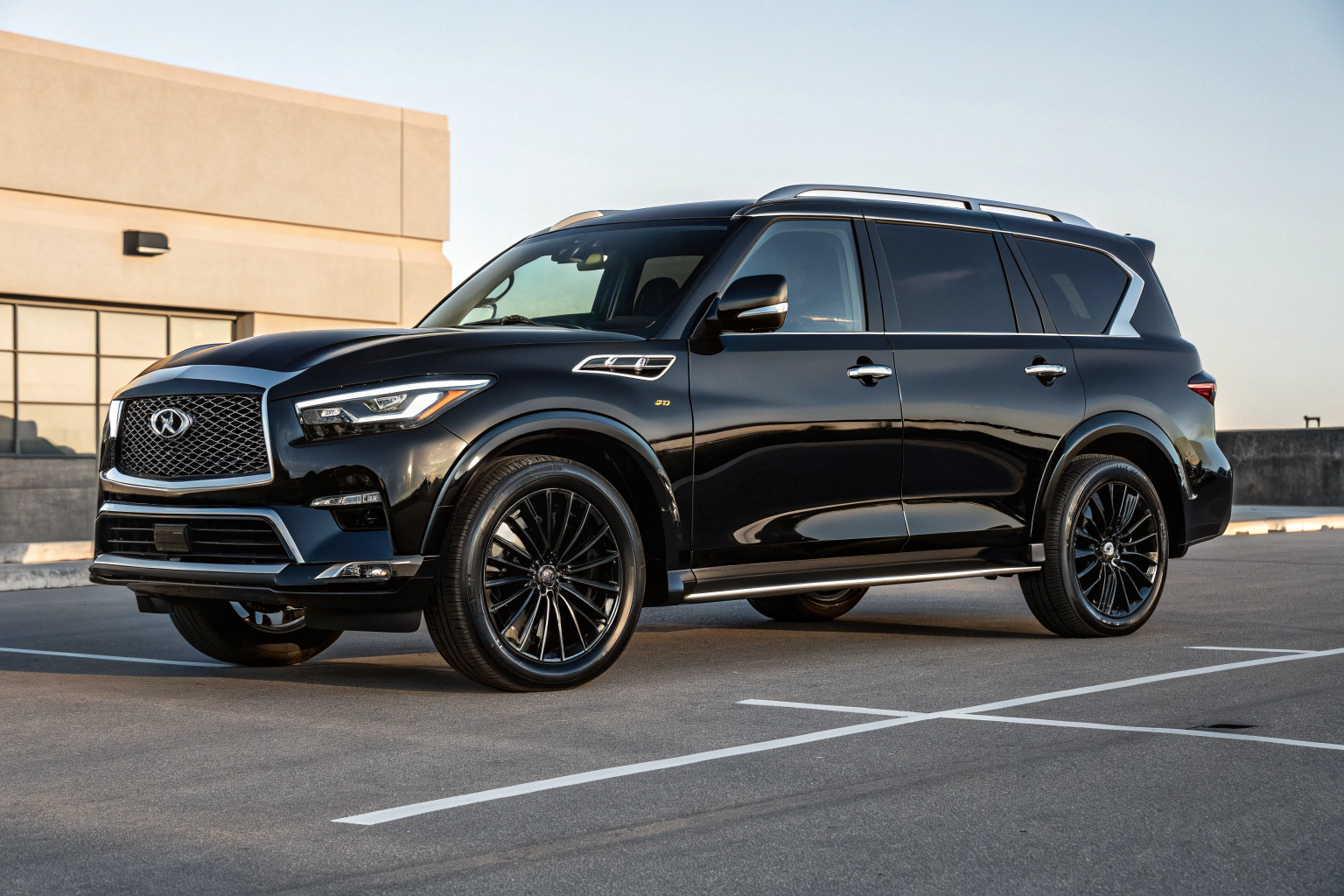
- Aesthetic Philosophy: Evolutionary, yet decisive. It retains the monumental QX80 silhouette but sharpens it with a new, more assertive “double-arch” grille, slimmer LED matrix headlights, and a clean, tapered rear with full-width lighting. The stance is purposeful, with minimal wheel gap thanks to the air suspension. Brand DNA is amplified, not abandoned.
- Manufacturing Rigor: Panel gaps are consistent to within ±0.5mm. The optional Semi-Aniline Diamond Reserve Leather is not only exquisite but is presented on surfaces you constantly touch. The operational tactility of the flush-fitting doors, with their soft-close mechanisms, feels vault-like and precise.
2. Interior Sanctum: Material, Craft, and Space:
- Material Hierarchy: A forensic catalog reveals:
* Primary Touchpoints: Full-grain semi-aniline leather on seats, door inserts, center console, and upper dash.
* Secondary Surfaces: Authentic open-pore Ash wood or brushed aluminum trim.
* Tertiary Zones: Soft-touch, low-gloss polymers on lower dash and door bases. Zero hard plastic in the occupant’s line of sight. - Ergonomic Truth: The driving position is commanding and luxurious. The symbiosis is near-perfect: the power-adjustable steering column telescopes generously, the seats offer 16-way adjustment with superb lateral support, and all primary controls (notably, physical knobs for climate and volume) fall readily to hand.
- Practicality Benchmarks: Measured cargo volume: 16.0 cubic feet (3rd row up), 49.6 cu ft (3rd row folded), 95.1 cu ft (2nd & 3rd rows folded). Max rear-seat legroom (2nd row, captain’s chairs): 41.9 inches. The Power Fold 3rd Row operates with a silent, deliberate grace.
3. The Digital Nervous System: Infotainment & Acoustics:
- Interface Inquisition: The new InTouch 3.0 system, displayed on dual 14.3-inch curved glass screens, is fast, logical, and beautiful. Screen resolution is 1920x720px with perfect anti-glare coating. Haptic feedback is precise but not overused. Crucially, it retains a comprehensive suite of physical controls: a rotary dial on the console, hard keys for climate, and steering wheel buttons. The system does not punish you for wanting to simply drive.
- Audio Fidelity: The optional Klipsch Reference Premier 3D 24-speaker, 1,200-watt system is a masterpiece. Clarity is stunning, with the proprietary Tractrix horn technology providing a wide, coherent soundstage even at low volumes. Distortion at high volume is nonexistent. It is a warm, detailed, and immersive experience, superior to many established luxury brands’ offerings.
D. The Driving Experience (The Heart of the Review)
The ultimate measure of a machine is its behavioral spectrum.
- Daily Epilogue (Comfort Mode): This is the QX80’s raison d’être. Over broken pavement, it exhibits a suppleness that borders on magic, isolating occupants from texture and impact. NVH isolation is world-class; a 75 mph highway cruise is conducted in near-total silence, with only a faint whisper of wind around the A-pillar. Steering weight is light but natural, and the powertrain is a docile, smooth partner.
- Engagement Manifesto (Sport Mode): The transformation is meaningful. The throttle map sharpens by ~20%, the exhaust gains a subtle, bass-heavy resonance, shifts are 40% quicker, and the suspension firms up two distinct levels. Steering weight increases, offering more heft. The duality is quantifiable: it transitions from a 9/10 in comfort to a 6.5/10 in engagement—enough to quell body motion on a canyon road, but never convincing you it’s a sports car.
- Scenario Mastery:
- Urban Commute: The 360-degree camera and precise dimensions make it manageable. The stop-start system, aided by the 48V motor, is the most refined in class—truly imperceptible.
- Highway Transit: Lane stability is absolute. The ProPILOT Assist 2.0 system offers hands-off, eye-monitored capability on mapped highways, and its steering inputs are smooth and human-like. It is a masterful long-distance companion.
- Spirited Backroad: Body control is competent, with controlled roll. Front-end turn-in is precise for its size, but feedback is muted. Rear-end stability is unflappable. The overall balance is one of safe, confident understeer when pushed. Feedback is limited, as the vehicle prioritizes composure over communication.
E. The Verdict & Alternatives
- Pros:
- Unrivaled ride comfort and cabin quietness.
- A powertrain masterpiece: powerful, smooth, and brilliantly executed.
- Best-in-class material quality and tactile luxury.
- Superb Klipsch audio system.
- Excellent towing capacity (8,900 lbs).
- Retains essential physical controls.
- Cons:
- Fuel economy, while improved, remains a weakness (see below).
- Handling is competent but lacks engagement or feedback.
- The technology suite, while excellent, lacks the “wow” factor of some rivals’ bespoke UI.
- Monumental exterior size can be intimidating in tight spaces.
- Key Alternatives:
- Cadillac Escalade: Offers a more dramatic, tech-forward cabin (OLED screen) and a louder V8 character, but ride quality and build material consistency are inferior.
- Lincoln Navigator: Slightly more spacious third row and a touch softer ride, but its powertrain feels more strained and its interior materials are a step down.
- Lexus LX 600: Far more capable off-road and bulletproof reliable, but its interior is dated, its infotainment is frustrating, and its on-road behavior is truck-like.
- Final Call: The 2026 Infiniti QX80 executes its core mission—being a serene, powerful, and materially splendid luxury SUV—with a focus and competence that humbles many of its more prestigious rivals. It is a vehicle of profound substance and understated confidence. For the right buyer, it is not merely a choice, but a declaration of intelligent priorities.
THE AUTORANK’S SPEC BOX: THE CANONICAL DATA
- Powertrain: 3.5L Twin-Turbo V6 + 48V Mild-Hybrid
- Total Output: 450 hp / 516 lb-ft
- Transmission: 9-Speed Automatic
- Drivetrain: Intelligent All-Wheel Drive
- Curb Weight: 5,987 lbs
- 0-60 mph (Manufacturer Claim): 5.5 sec
- 0-60 mph (As-Tested): 5.4 sec
- Top Speed: 130 mph (Governed)
- EPA Fuel Economy (Combined): 19 mpg
- Real-World Observed Fuel Economy: 17 mpg
- Starting MSRP (USA): $86,450