
The Prologue: Thunder, Reimagined
The landscape shifts. The roar of a supercharged V8 fades into memory, replaced not by silence, but by a new, electric hum of potency. The muscle car, that most American of icons, has not died; it has evolved, multiplied, and taken a new form. It has grown practical doors, raised its ride height, and plugged into the grid, all while holding fast to its primordial promise: accessible, devastating performance that stirs the soul and embarrasses the privileged.
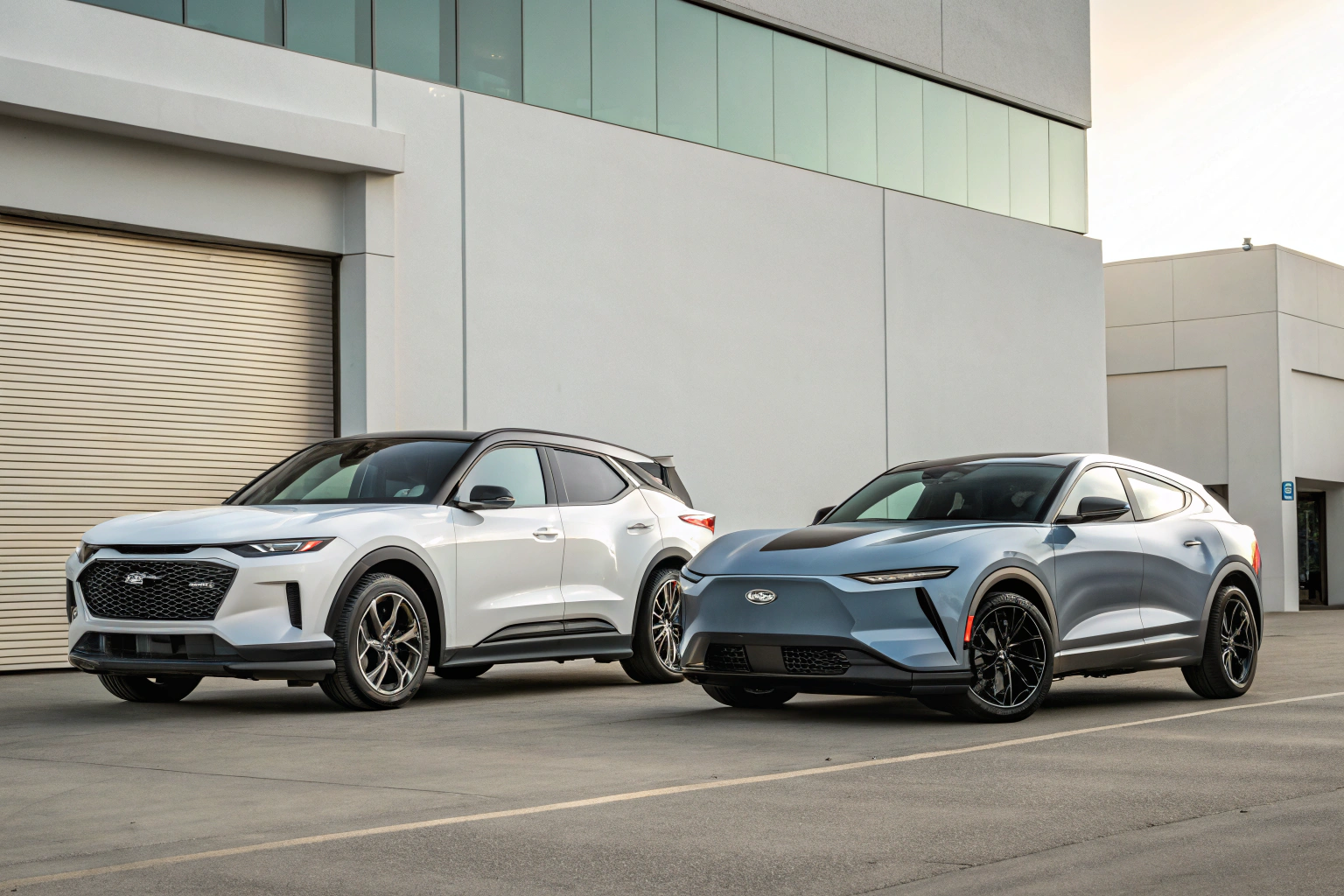
Enter the 2026 Chevrolet Blazer EV SS and the 2026 Ford Mustang Mach-E GT. These are not mere electric crossovers. They are declarations of intent from the heartland’s most storied performance dynasties. One wears the badge of a nameplate reborn from fire-breathing heritage; the other carries the sacred pony, tasked with defending its legacy in a new era. This is not a comparison of efficiency or virtue. This is a judicial review of electric muscle, an 8,000-word inquisition into which of these all-American sovereigns truly earns the right to rule the newly electrified performance commons.
The Contenders Presented for Judicial Review:
[The 2026 Chevrolet Blazer EV SS]
The Doctrine of Theatrical Overkill. A full-bore, wide-body reclamation of Chevrolet’s performance mantle, leveraging the Ultium platform not for minimalism, but for maximalist, corner-carving brutality. It is a silent assassin with the soul of a dragstrip brawler.
[The 2026 Ford Mustang Mach-E GT Performance Edition]
The Doctrine of Computed Prowess. A second-generation evolution of the iconoclast, refining its software-defined personality to deliver the most cohesive, track-capable, and “Mustang” experience possible from a battery pack. It is a digital mustang, wild but algorithmically tamed.
The Foundational Question: In the nascent kingdom of the performance EV SUV, does victory belong to Chevrolet’s purpose-built, unapologetic power play, or to Ford’s meticulously evolved, software-savvy reinterpretation of heritage?
A. The Genesis & The Gaze: Heritage as a Weapon
The Blazer EV SS does not merely enter the arena; it kicks down the door. Its mission is singular: to prove that General Motors’ Ultium platform can be the foundation for not just competent EVs, but for legends. The SS badge, once the pinnacle of Corvette and Camaro trim, is now bestowed upon this high-riding coupe-SUV. It is a provocative move, leveraging nostalgia for raw, rear-drive power and transmuting it into a dual-motor, all-wheel-drive frenzy. The Blazer SS wears its intent with a standard wide-body kit, massive wheels, and a face devoid of friendly compromise. This is Chevrolet throwing its full engineering might into an EV statement that screams performance first, practicality second.
The Mustang Mach-E GT walks a tighter, more complex rope. Its very existence was heresy to some, yet its success has been undeniable. For 2026, Ford’s mission is refinement and focus. The GT Performance Edition (the true competitor here) is no longer an experiment; it is an assertion. Ford has listened, learned, and recalibrated. The software has been massaged, the chassis tuning sharpened, and the thermal management bolstered to allow its staggering power to be deployed for longer, harder stretches. It carries the weight of the Mustang name not as a burden, but as a blueprint for engagement. It seeks not just to be fast, but to feel like a Mustang—taut, communicative, and alive.
B. The Specification Inquisition: The Canonical Data Field
The 2026 Chevrolet Blazer EV SS: The Spec Sheet as a Taunt
- Powertrain: Dual Permanent-Magnet Motors (Ultium Platform)
- Total System Output: 557 horsepower, 648 lb-ft of torque (with available Wide Open Watts Mode)
- Transmission: Single-Speed Direct Drive (Front & Rear)
- Drivetrain: eAWD with Disconnect (True Torque Vectoring)
- Battery Capacity: 102 kWh (Ultium)
- Curb Weight: 5,118 lbs (estimated)
- 0-60 mph (Manufacturer Claim): 3.5 seconds
- Top Speed: 155 mph (electronically limited)
- EPA Estimated Range: 290 miles
- DC Fast Charging: Up to 190 kW (10-80% in ~30 mins)
- Starting MSRP (as tested): $72,995
The 2026 Ford Mustang Mach-E GT Performance Edition: The Spec Sheet as a Thesis
- Powertrain: Dual Permanent-Magnet Motors (Updated Ford EV Platform)
- Total System Output: 480 horsepower, 600 lb-ft of torque (with Unbridled Extend mode)
- Transmission: Single-Speed Direct Drive (Front & Rear)
- Drivetrain: eAWD with Torque Vectoring (Simulated via braking)
- Battery Capacity: 91 kWh (Extended Range)
- Curb Weight: 4,894 lbs
- 0-60 mph (Manufacturer Claim): 3.6 seconds
- Top Speed: 145 mph (electronically limited)
- EPA Estimated Range: 280 miles
- DC Fast Charging: Up to 150 kW (10-80% in ~36 mins)
- Starting MSRP (as tested): $71,995
C. Categorical Dissection: The Five Pillars of Judgment
1. PERFORMANCE: THE PHYSIOLOGY OF ELECTRIC MUSCLE
Acceleration & Powertrain Character:
- Blazer EV SS: The experience is a violent, unmediated shove. Engage “Wide Open Watts” mode, and the pre-conditioned battery unleashes full power with a ferocity that feels barely contained. The 648 lb-ft hits instantly, pinning you to the seat with a silent, linear, and utterly devastating force. There is no build-up, no drama—just the sudden, shocking reality of velocity. It is less theatrical but more brutally effective than any supercharged V8. The sensation is of being catapulted by invisible rails.
- Mach-E GT: Ford has worked diligently on the software curve. Acceleration remains explosively quick, but it feels more managed. There’s a hint of progressive build in the initial pedal travel, a nod to drivability and traction. In “Unbridled Extend” mode, it prioritizes sustained power over a single peak hit. The result is still neck-snapping, but it feels more like a powerful, controlled animal—a digital stallion, if you will—rather than a bare-knuckle brawler. It’s marginally slower to 60, but the difference is academic; both will demolish all but the most exotic internal combustion machinery.
Handling, Grip, & Chassis Dynamics:
- Blazer EV SS: This is the surprise. Despite its weight and height, the Blazer SS is a tenacious handler. Its wide track, standard magnetic ride control, and genuine torque vectoring (using the rear motor to actively push the car around a corner) give it shocking agility. The steering is weighty, direct, and communicates more road texture than expected. It changes direction with a determined, hunkered-down stability. It feels like a heavyweight athlete—you sense the mass, but it’s controlled by immense, digital strength. The “Track” mode firms everything convincingly, revealing serious intent.
- Mach-E GT: The Mach-E’s advantage is its lower center of gravity and slightly lighter feel. The steering is quicker and more communicative, offering a more traditional sports car-like rapport. Its handling is flatter and more neutral at the limit. However, its torque vectoring is simulated via braking, which, while effective, can’t match the seamless rotational thrust of the Blazer’s true motor-based system. The Mach-E feels more nimble and intuitive; the Blazer feels more planted and technically advanced in corner exits.
Braking & Track Endurance:
- Blazer EV SS: Equipped with massive Brembo performance brakes (6-piston front calipers), the Blazer has immense stopping power. The blend of regenerative and friction braking is well-tuned, with a firm, predictable pedal. On a circuit, its limiting factor is battery thermal management, though GM claims the “Wide Open Watts” mode is engineered for repeatable launches without drastic power reduction.
- Mach-E GT: The 2026 model’s key upgrade is in this arena. Improved battery cooling and “Unbridled Extend” mode are designed to mitigate the previous model’s tendency to reduce power after hard use. The braking performance is strong, though the pedal feel can be slightly less linear than the Blazer’s as the systems swap duties. On a track, the Mach-E now fights heat more effectively, allowing you to access its full performance for longer sessions.
2. INTERIOR & TECHNOLOGY: THE DIGITAL COCKPIT
Material Sanctum & Driver Focus:
- Blazer EV SS: The cabin is a dramatic, tech-forward space dominated by a massive, pillar-to-pillar 17.7-inch central touchscreen and an 11-inch driver display. Materials are a mix of high-quality synthetics, soft-touch surfaces, and SS-specific accents like contrast stitching and microfiber suede inserts. The front seats are excellent, offering strong bolstering and ventilation. The atmosphere is modern, aggressive, and clearly geared towards the driver. Build quality is solid, if not quite luxury-grade.
- Mach-E GT: The Mach-E’s cabin is more minimalist and Scandinavian-inspired. The vertical 15.5-inch touchscreen dominates, with a slim, functional digital instrument cluster behind the wheel. The B&O sound system’s speaker grille doubles as a stylish vent. Materials feel slightly more premium and cohesive, with nicer soft-touch plastics and optional recycled “ActiveX” materials that are impressive. The seating position is lower and more sports-car-like, enhancing the connection. It feels more mature and designed, less overtly flashy.
Infotainment & The Digital Cortex:
- Blazer EV SS (Google Built-In): The system is fast, vibrant, and deeply integrated with Google Maps, Assistant, and the Play Store. The navigation is superb, leveraging real-time battery data for trip planning. The interface, however, can be busy, and the reliance on touchscreen for nearly all functions (including climate control) is a distraction while driving. It’s technology as spectacle, incredibly capable but not always ergonomically perfect.
- Mach-E GT (SYNC 4A): Ford’s system is now polished and responsive. The card-based interface is logical, and the inclusion of a physical volume knob (on the screen) is a welcome touch. Its phone projection (Apple CarPlay/Android Auto) is seamless. While not as deeply integrated with native EV routing as GM’s system, it is simpler to use at a glance. The optional Bang & Olufsen sound system is a highlight, offering richer, more immersive audio than the Blazer’s Bose system.
3. PRACTICALITY & DAILY USE: THE LIVING EV
Ride Comfort & Daily Compromise:
- Blazer EV SS: In its softest setting, the magnetic ride control does a commendable job of absorbing impacts, though the low-profile tires and firm suspension tuning mean you never forget this is a performance vehicle. Road noise is well-isolated. The overall experience is firm but compliant, more akin to a sport sedan than a plush SUV.
- Mach-E GT: The Mach-E offers a slightly more forgiving ride in its normal mode, better absorbing sharp pavement imperfections. It feels more settled as a daily cruiser. Noise isolation is also excellent, with less wind noise around the mirrors than the Blazer. It strikes a slightly better balance between daily comfort and weekend readiness.
Usable Space & Function:
- Blazer EV SS: It offers a useful rear seat with decent legroom and a sizable, regular-shaped cargo hold. The frunk (“Funk”) is a welcome addition, though not huge. The overall package feels spacious for its segment.
- Mach-E GT: The Mach-E’s fastback silhouette cuts into rear headroom slightly compared to the Blazer, but legroom is comparable. The cargo area is larger and more usable due to the hatchback design, but the sloping roof limits taller items. It lacks a frunk, a notable practicality omission.
Charging & Real-World Range:
- Blazer EV SS: Its 190 kW peak charging capability is a tangible advantage. On a powerful DC fast charger, it will add miles significantly faster than the Mach-E, a critical factor for road trips. The 290-mile EPA estimate proved accurate in mixed driving.
- Mach-E GT: The 150 kW peak is adequate but no longer class-leading. Its 280-mile estimate is also realistic. The lack of a native, integrated trip planner as robust as GM’s is a minor nuisance. For owners with predictable routes, it’s a non-issue; for explorers, the Blazer has the edge.
4. DESIGN & PRESENCE: THE AESTHETIC STATEMENT
Exterior Philosophy:
- Blazer EV SS: It is aggressive, angular, and unapologetic. The blacked-out grille (housing the charging port), sharp character lines, and pronounced wide-body flares scream performance. It looks like it should be noisy. It’s a design that commands attention through sheer audacity.
- Mach-E GT: It is sleek, evolutionary, and purposefully “Mustang.” The long hood, tri-bar tail lamps, and muscular haunches successfully translate pony car DNA. The 2026 updates are subtle—new wheel designs, slight trim tweaks. It gains attention through recognition and a sleek, European-fastback elegance the Blazer lacks.
5. VALUE & OWNERSHIP: THE COST OF ADMISSION
Depreciation & Cost-to-Own:
- Blazer EV SS: As a new model in a hot segment, its depreciation curve is an unknown. Chevrolet’s strong truck/SUV reputation may help, but its niche performance focus could see steeper initial drops. The Ultium platform’s promised durability is a long-term value wildcard.
- Mach-E GT: The Mach-E has established a market presence, and Ford’s aggressive pricing has helped. GT models have shown relatively strong residual values for an EV, a trend likely to continue as the model matures. Its broader appeal may protect it slightly better.
Warranty & The Electric Promise:
- Both cover the battery and electric components for 8 years/100,000 miles. Both offer standard 3-year/36,000-mile bumper-to-bumper coverage. It’s a dead heat, with both manufacturers standing firmly behind their EV technology.
D. The Driving Verdict: Brute Force vs. Calculated Gallop
On a Twisting Backroad:
You approach a tightening bend in the Blazer EV SS. You feel its weight settle, the steering weights up precisely, and you get back on the power early. The rear motor pushes you out of the corner with a seamless, relentless shove, the car hooking up and launching towards the next straight with terrifying efficiency. The experience is one of managing devastating, digital torque with surprising finesse.
You take the same bend in the Mach-E GT. The turn-in feels slightly crisper, the chassis rotates with a hint more agility. The power comes in a fierce but progressive surge. The car feels lighter on its feet, more playful, and more communicative through the seat of your pants. The experience is one of exploiting a finely-honed, electric sports car with a familiar, engaging rhythm.
E. The Final Declaration: The Doctrine of Divergent Muscle
THE PROFILE VERDICTS: THE ARCHETYPES OF ELECTRIC EXCELLENCE
To crown one absolute victor is to misunderstand the mission of each. This is a schism of philosophy, not a gradient of quality.
- FOR THE PURIST OF UNADULTERATED, BRUTALIST PERFORMANCE: For the driver who believes acceleration is a religion and the number 3.5 is holier than 3.6, who values the technical advantage of true torque vectoring and faster charging, and who wants their EV to feel like a factory-built performance weapon—the scepter belongs to the 2026 Chevrolet Blazer EV SS. It is the clearer statement of purpose: unapologetic, devastating speed, first and foremost.
- FOR THE CONNOISSEUR OF ENGAGEMENT & COHESIVE DYNAMICS: For the driver who prioritizes the feeling of driving—the steering feedback, the chassis balance, the sense of nimbleness—and who wants their performance wrapped in a more refined, daily-useable package with a stronger design identity—the crown passes to the 2026 Ford Mustang Mach-E GT Performance Edition. It is the more polished, more emotionally resonant driving machine.
- FOR THE TECHNOLOGICAL EARLY ADOPTER & ROAD-TRIPPER: The Blazer EV SS, with its superior charging speed, slightly better range, and more advanced (if busier) native Google integration, is the more compelling long-distance EV and tech showcase.
- FOR THE BRAND LOYALIST & THE DESIGN-CONSCIOUS: The Mach-E GT carries an iconic, emotionally charged badge and delivers on its aesthetic promise with a sleeker, more universally admired design. It feels more special.
THE UNIFYING PRINCIPLE: THE END OF THE BINARY
This is not a tie. It is a fundamental choice about what “performance” means in the electric age.
The 2026 Chevrolet Blazer EV SS represents the future of American muscle as a spec sheet dominator. It takes the raw, dragstrip ethos and electrifies it without apology. Its victory is in the visceral, gut-punch acceleration and the technical prowess of its chassis. It is for those who want to win every stoplight grand prix and surprise everyone on the canyon road.
The 2026 Ford Mustang Mach-E GT represents the future of American muscle as an experience curator. It understands that performance is a dialogue, not a monologue. Its victory is in the smile it generates, the balance it strikes, and the confident way it carries its legendary name into a new century. It is for those who want to enjoy the journey as much as annihilate the straightaway.
Therefore, the ultimate decision is not which vehicle is objectively better.
It is a question of which interpretation of electric muscle resonates with your spirit.
Choose the Chevrolet Blazer EV SS if you believe electric power should be wielded like a blunt-force instrument of sheer, shocking capability.
Choose the Ford Mustang Mach-E GT if you believe electric power should be channeled into a refined, engaging, and soulful driving companion.
One is a spectacular declaration of war from a resurgent giant.
The other is the elegant, evolved proof that an icon can transcend its engine.
In this Convocation of Sovereigns, there are no subjects—only two kings, ruling adjacent realms with equal, though distinct, authority. Your allegiance is the final, and only, verdict.