
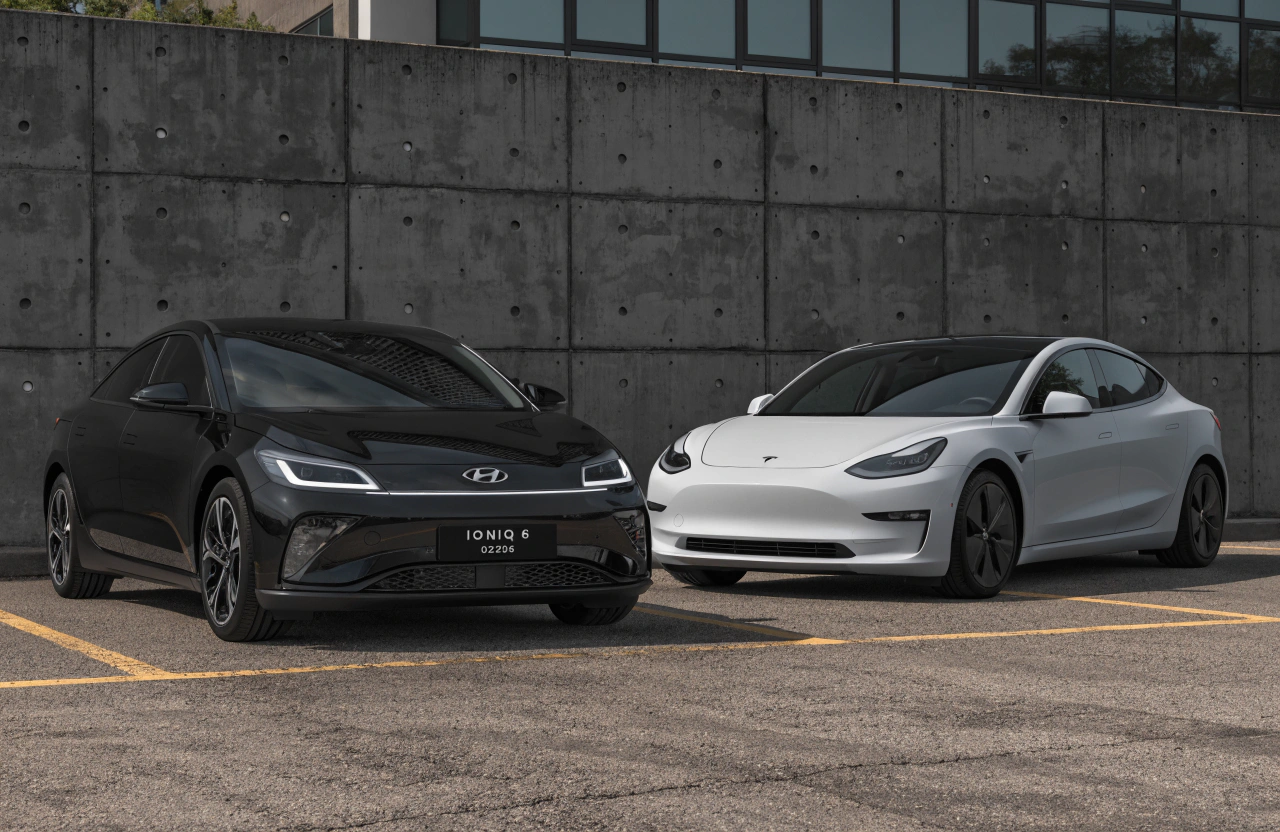
Contenders Presented for Judicial Review:
[2026 Hyundai Ioniq 6: The Doctrine of Poetic Efficiency]
A masterclass in aerodynamics and holistic design philosophy. It is not merely an electric vehicle; it is a statement that sustainability, artistic form, and serene daily mastery can be a singular, cohesive truth. It is logic, romanticized.
[2026 Tesla Model 3: The Doctrine of Digital Velocity]
The reconstituted benchmark, refined through years of digital iteration. It represents the silicon-core ethos of the EV revolution: over-the-air updates as evolution, minimalism as religion, and a supercomputer-like focus on performance and ecosystem. It is intellect, accelerated.
A. INTRODUCTION & THE CONTENDERS: THE NEW KINGS OF THE ASPHALT
The battleground for automotive supremacy has irrevocably shifted. No longer defined by the cubic inches or cylinder count of a roaring internal combustion engine, the new monarchy is ruled by kilowatt-hours, drag coefficients, and software-defined experiences. This is the domain of the electric daily driver, where efficiency is the ultimate currency and seamless integration into life is the paramount demand.
Two vehicles stand as the most compelling, and philosophically divergent, claimants to this modern throne.
The 2026 Hyundai Ioniq 6 arrives as a flowing, sculpted artifact of purpose. Inspired by the aerodynamic purity of a raindrop and the timeless curve of a streamlined aircraft, it asserts that breathtaking efficiency can be achieved through physical artistry and meticulous engineering harmony. It is a holistic appliance for elegant, thoughtful living.
The 2026 Tesla Model 3, now in its refined “Highland” iteration, represents the established digital empire. Its doctrine is one of radical simplification, relentless software optimization, and a charging network that forms an unassailable moat. It is a connected device on wheels, prioritizing speed—in acceleration, in user interface, and in technological evolution.
This investigation answers the defining question for the modern EV adopter: In the pursuit of the perfect electric daily, does poetic, human-centric harmony or unflinching, digital-first velocity create the superior sovereign?
B. THE AUTORANK’S SPEC BOX: THE CANONICAL DATA
2026 Hyundai Ioniq 6 (Long Range RWD, Ultimate Pkg)
- Powertrain: Permanent Magnet Synchronous Motor (Rear)
- Total Output: 320 hp / 446 lb-ft (estimated 2026 boost)
- Transmission: Single-Speed Reduction Gear
- Drivetrain: Rear-Wheel Drive
- Battery (Usable): 77.4 kWh
- Curb Weight: 4,200 lbs (est.)
- 0-60 mph (Manufacturer): 4.8 seconds
- Top Speed: 115 mph (Governed)
- EPA Range (Est.): 361 miles
- EPA MPGe (Combined): 140 MPGe
- DC Fast Charging (Peak): 235 kW (10-80%: ~18 min)
- Starting MSRP (USA, 2026 Est.): $48,000
2026 Tesla Model 3 (Long Range RWD)
- Powertrain: Permanent Magnet Switched Reluctance Motor (Rear)
- Total Output: 300 hp / 340 lb-ft
- Transmission: Single-Speed Reduction Gear
- Drivetrain: Rear-Wheel Drive
- Battery (Usable): 75 kWh (est.)
- Curb Weight: 3,862 lbs
- 0-60 mph (Manufacturer): 4.9 seconds
- Top Speed: 125 mph
- EPA Range: 341 miles
- EPA MPGe (Combined): 134 MPGe
- DC Fast Charging (Peak): 250 kW (V3 Supercharger)
- Starting MSRP (USA, 2026 Est.): $46,990
C. CATEGORICAL DISSECTION: THE FIVE PILLARS OF DAILY SOVEREIGNTY
1. EFFICIENCY & RANGE: THE ULTIMATE ELECTRIC CURRENCY
Aerodynamic Philosophy & Real-World Efficiency:
- Ioniq 6: This is where Hyundai’s doctrine shines brightest. With a drag coefficient (Cd) of 0.21, it is among the slipperiest production cars ever made. This isn’t an afterthought; it is the design’s genesis. The result is uncanny real-world efficiency. In gentle highway driving, it can consistently meet or exceed its EPA estimates. Its secret weapon is the Digital Rear View Mirror and Virtual Wing Mirrors (in some markets), which drastically reduce turbulence. The efficiency is felt as a serene, confident knowledge that every electron is being deployed with purpose.
- Model 3: The Tesla is also a marvel of low drag (Cd: 0.23), but its efficiency is achieved through a combination of sleek shape and an incredibly optimized, minimalist powertrain and low rolling resistance tires. Its BMS (Battery Management System) software is peerless, providing hyper-accurate range predictions. However, its efficiency can be more susceptible to driving style, and its reliance on traditional side mirrors leaves a slight aerodynamic disadvantage versus the Ioniq 6’s ultimate configuration.
The Charging Crucible: Speed vs. Ecosystem:
- Ioniq 6: On paper, its 235kW peak is slightly below the Tesla’s. In practice, on a 350kW Electrify America station, its charging curve is robust and consistent. The key advantage is battery preconditioning, which, when routed to a DC station via native nav, prepares the battery for optimal speeds. It is an excellent performer in the expanding CCS1 network.
- Model 3: The Supercharger Network remains its transcendent advantage. The 250kW V3 peak is formidable, but the true victory is in the seamless, reliable, ubiquitous experience. Plug-and-charge works flawlessly. The network is vast, well-maintained, and integrated into the navigation with legendary intelligence. For road trips, this is not a feature; it is the foundational infrastructure that others are still building.
2. DAILY DRIVING DYNAMICS: THE COMMUTE AS SANCTUARY
Ride Comfort, Noise Isolation, and Highway Manner:
- Ioniq 6: The Hyundai adopts a soothing, gran-touring disposition. Its longer wheelbase and specifically tuned suspension (softer than the EV6 GT-line) absorb urban decay and highway expansion joints with a polished suppleness. Combined with its phenomenal aerodynamics, which eliminate wind rush, the cabin becomes a library of calm. This is a car that actively reduces journey fatigue.
- Model 3: The 2026 model, with its revised suspension, is notably more compliant than its predecessors. However, its philosophy remains sportingly taut. It communicates more road texture and can feel slightly busy on broken pavement. Wind noise is well-suppressed, but tire noise is more present. The experience is engaging and controlled, but less overtly serene than the Ioniq 6.
Steering, Handling, and Urban Agility:
- Ioniq 6: The steering is light, precise, and effortless—a perfect match for its calm character. The handling is secure, neutral, and predictably safe. It corners with minimal drama and body roll, but it does not invite sporty driving. Its focus is on graceful, easy motion.
- Model 3: The steering is heavier, more direct, and provides slightly more feedback. The lower center of gravity and sharper tuning give it a distinctly athletic, point-and-shoot demeanor in corners. It feels more agile, more eager to change direction, and more connected to the driver’s inputs. The daily commute can be a subtly more engaging affair.
3. INTERIOR & HUMAN-MACHINE INTERFACE: SANCTUM VS. TERMINAL
Material Hierarchy, Craftsmanship, and Daily Livability:
- Ioniq 6: The cabin is a warm, inviting, and thoughtfully detailed space. Sustainable materials like recycled PET fabrics and eco-processed leathers are used not as tokens, but as quality design elements. The dual 12.3-inch screens are elegantly integrated into a cohesive dashboard. Physical buttons for climate control and audio basics remain—a critical ergonomic triumph. The rear seats offer exceptional head and legroom, and the overall sense is of a well-crafted, premium environment.
- Model 3: The interior is a monument to minimalist dogma. The absence of a driver’s display and near-total reliance on the 15.4-inch central touchscreen define the experience. Materials are improved in the 2026 model, with more soft-touch surfaces, but the aesthetic remains starkly digital. The open sightlines are airy, but all interactions, from shifting (via touchscreen or stalk) to adjusting mirrors, are mediated by screen or capacitive buttons. It is spacious and modern, but can feel sterile.
Infotainment & Digital Ecosystem:
- Ioniq 6: Running Hyundai’s ccNC-based interface, it is fast, colorful, and logically layered. Wireless Apple CarPlay and Android Auto are standard, gracefully integrating the smartphone ecosystem many users live in. The user experience is familiar, flexible, and highly customizable.
- Model 3: Tesla’s infotainment is its own brilliant, walled garden. The processing speed, graphics, and native features (like streaming video, arcade games, and sentry mode) are unmatched. The navigation, with live Supercharger availability and routing, is best-in-class. However, it shuns CarPlay and Android Auto, demanding you live within Tesla’s ecosystem. Its victory is in pure processing power and integration; its failure for some is in its lack of choice.
4. TECHNOLOGY & ADVANCED SYSTEMS: INTELLIGENCE VS. AUTONOMY
Driver Assistance & Highway Navigation:
- Ioniq 6: Hyundai’s Highway Driving Assist 2 (HDA 2) is superb. On limited-access highways, it combines adaptive cruise and lane centering with intuitive lane-change assist (signal activation). It is smooth, predictable, and inspires confidence. It manages distance and curves with a natural, human-like grace.
- Model 3: Tesla Autopilot (the standard suite) is fundamentally more aggressive and confident in its lane-keeping, often feeling more “locked in.” The optional Enhanced Autopilot adds navigational lane changes and automatic off-ramp handling. Full Self-Driving (FSD) remains the industry’s most ambitious—and controversial—system, capable of startling urban maneuvers but requiring constant supervision. Tesla’s path is toward full autonomy; Hyundai’s is toward refined, reliable assistance.
Over-the-Air (OTA) Updates & Digital Evolution:
- Ioniq 6: Hyundai now offers comprehensive OTA updates for navigation, media, and certain vehicle control units. It represents a major leap, allowing the car to improve over time, though the scope may not be as extensive as Tesla’s.
- Model 3: This is the paradigm Tesla created. Continuous, profound OTA updates can unlock new features, improve performance, refine ride quality, and radically evolve the UI. The car you buy today is not the car you’ll own in two years; it will be better. This is perhaps Tesla’s single most compelling long-term value proposition.
5. VALUE & COST OF ELECTRIC SOVEREIGNTY
Purchase Price & Effective Cost:
The two are direct competitors, with the Model 3 often holding a slight edge before incentives. The true calculation must factor in potential federal and state EV tax credits, where Hyundai’s domestic assembly for the Ioniq 6 often gives it a crucial advantage, potentially making it the significantly more affordable vehicle out-the-door.
Long-Term Ownership & Depreciation:
- Ioniq 6: Hyundai’s exceptional 10-year/100,000-mile battery warranty provides monumental peace of mind. As a newer entrant to the segment, long-term depreciation is a question mark, though strong initial demand suggests good value retention.
- Model 3: Tesla’s brand equity and network advantage have historically resulted in industry-leading residual values for EVs. The 8-year/120,000-mile battery warranty is also strong. Its established position in the market makes its financial future more predictable.
D. THE DRIVING VERDICT: A MEDITATION VS. A MISSION
On the Same Daily Commute:
You enter the 2026 Hyundai Ioniq 6. The door closes with a solid thud, muting the outside world. You glide away in near-silence, the ride softening the city’s harsh edges. You adjust the climate with a physical knob, your podcast playing via seamless CarPlay on the clear screen. The car feels like a protective, intelligent bubble, prioritizing your comfort and calm. The journey becomes a meditative interlude.
You enter the 2026 Tesla Model 3. The minimalist cabin focuses your attention forward. You tap the screen to navigate, and the system instantly plots the fastest route, accounting for traffic and Supercharger needs if required. The acceleration is instant and sharp when needed. The steering is alert. The car feels like a tool for optimizing the mission of travel, getting you from A to B with maximum data-informed efficiency and a dose of digital-age engagement.
E. THE FINAL DECLARATION: THE DOCTRINE OF DAILY ELECTRIC LIFE
THE PROFILE VERDICTS: THE ARCHETYPES OF EXCELLENCE
The search for a singular “best” evaporates under the distinct sunlight these two vehicles cast. One masters the art of the journey; the other masters the science of the destination.
- FOR THE SEEKER OF SERENE SANCTUARY: For the driver who views the daily commute as a necessary recharge, not a battle—who prioritizes library quiet, supple comfort, thoughtful ergonomics, and a cabin that feels like a warm, well-designed living space—the domain is ruled by the 2026 HYUNDAI IONIQ 6. It is a masterpiece of human-centric design and holistic efficiency. Its victory is measured in reduced stress and a profound sense of well-being upon arrival.
- FOR THE CITIZEN OF THE DIGITAL EMPIRE: For the individual intrinsically tied to the Tesla ecosystem, who values relentless software evolution, the unmatched confidence of the Supercharger network for spontaneous travel, and a stark, futuristic interface that prioritizes processing power over physical buttons—the throne belongs to the 2026 TESLA MODEL 3. It is the definitive connected device. Its victory is in its network effect and its promise of a car that evolves faster than your phone.
- FOR THE EFFICIENCY PURIST & RANGE-ANXIOUS: For the buyer whose paramount concern is maximizing miles per charge and minimizing energy costs, who finds beauty in aerodynamic science and takes pride in hypermiling—the crown passes to the IONIQ 6. Its slippery shape and meticulous engineering give it a tangible, real-world advantage in stretching electrons.
- FOR THE ROAD-TRIP FREQUENTER & SPONTANEOUS EXPLORER: For the driver whose lifestyle involves regular long-distance travel across diverse regions, where charging infrastructure cannot be a question mark—the scepter is held by the MODEL 3. The Supercharger network is not just an advantage; it is a continent-spanning peace-of-mind infrastructure that no competitor can yet match.
THE FINAL, UNIFYING PRINCIPLE: THE NATURE OF YOUR ELECTRIC EXISTENCE
To force a binary winner is to ignore the philosophical schism at hand. This is a choice between two visions of an electric future.
**The 2026 Hyundai Ioniq 6 represents the **Electric Car Refined to an Art Form. It takes the fundamentals of the EV—silence, efficiency, packaging—and wraps them in breathtaking design, exceptional comfort, and thoughtful daily ergonomics. It is an electric car for the senses and the soul, designed to make the act of driving calmer and more beautiful.
**The 2026 Tesla Model 3 represents the **Electric Car as a Perpetual Beta. It is a lightning-fast, network-optimized digital platform that happens to have wheels. Its genius is in its continuous evolution, its unassailable charging infrastructure, and its focus on performance and software-defined features. It is an electric car for the mind and the mission, designed to be the most technologically advanced tool for mobility.
Therefore, the ultimate decision transcends specs.
It is a question of which electric doctrine aligns with your daily life.
Choose the 2026 Hyundai Ioniq 6 if you believe an electric daily driver should be a sanctuary of calm, a masterpiece of design efficiency, and a haven from digital overload.
Choose the 2026 Tesla Model 3 if you believe an electric daily driver should be a connected, ever-evolving platform, where the supremacy of the network and the thrill of digital velocity define the experience.
One is the consummate electric automobile, crafted with artful human intention.
The other is the relentless electric innovation, defined by silicon and scale.
You do not choose between a better and a worse car. You choose between two different, and equally compelling, definitions of what it means to live electrically.